 Credit: Ievgenii Karanov, Chronicle.lu
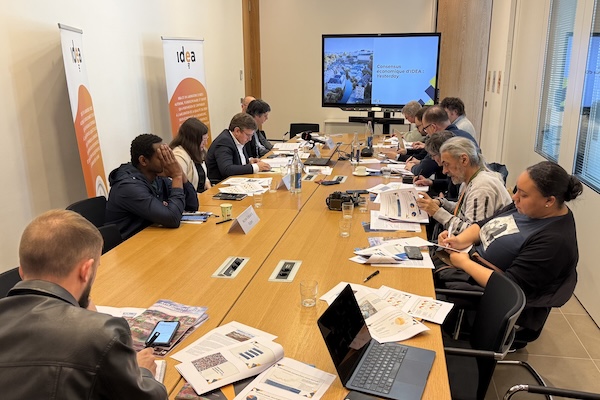
On Wednesday 15 April 2026, Fondation IDEA asbl presented its Annual Opinion 2026, entitled “Dissonances”, offering an analysis of the Luxembourg and international economic context, alongside a reflection on key structural challenges shaping the start of the year, at the House of Entrepreneurship in Luxembourg-Kirchberg.
Opening the presentation, Vincent Hein, Director of Fondation IDEA, explained that the Annual Opinion represents the foundation’s yearly “in-depth analysis” of Luxembourg’s economy, aimed at highlighting key socio-economic challenges in both the short and medium term. He added that, while IDEA is not a forecasting institute, it seeks to contribute to public debate by anchoring its analysis in structural issues and providing recommendations to policymakers.
Turning to the economic outlook, Vincent Hein described the current context as a “shock of uncertainty” extending the polycrisis that began in 2020, with risks of a global slowdown remaining “considerable”. He pointed to geopolitical tensions in the Middle East and potential supply disruptions as factors likely to impact energy prices and inflation. Focusing on Luxembourg, he said the country is experiencing a “homeopathic recovery” that is already under threat, with growth projections for 2025 revised down to around 0.6%, while average growth between 2022 and 2025 stood at just 0.3%, indicating a prolonged slowdown.
Ioanna Pop, economist at Fondation IDEA, noted that Luxembourg’s labour market showed “slight but encouraging signs of improvement” in 2025, although the recovery remains “slow and fragile”. Net job creation reached around 6,000 positions, significantly below the approximately 15,000 jobs created annually in the years before 2012. She added that 75% of new jobs were generated in the non-market sector, with public administration, education and health accounting for the majority, while sectors such as construction and information and communication remained in decline.
She further highlighted that the unemployment rate stood at 6.3% in February 2026, above the EU average of 5.9%, with the increase since 2022 affecting in particular lower-qualified workers and those aged over 45. Ioanna Pop also pointed to structural challenges, noting that cross-border workers accounted for 49% of net job creation in 2025, while more residents are moving abroad but continuing to work in Luxembourg. Among the key labour market challenges, she identified the slowdown in job creation, the uncertain impact of artificial intelligence, population ageing and evolving skills needs, stressing that adapting education and training systems and maintaining employability will be “essential” in the coming years.
Michel-Édouard Ruben, economist at Fondation IDEA, focused on public finances, noting that recently announced and planned tax measures, including the introduction of a single tax class and a further 1% reduction in corporate tax, are expected to have a structural budgetary impact of around €1.9 billion per year. He explained that this could shift Luxembourg’s public finances from a surplus of approximately €800 million in 2024 to a “more marked deficit” by 2029, with tax cuts significantly contributing to this deterioration.
Michel-Édouard Ruben also raised the possibility of a “strategic widening of the deficit” linked to expansionary fiscal policy, suggesting that continued tax reductions could create the conditions for future fiscal tightening. He further highlighted challenges related to talent attraction and retention, proposing adjustments such as extending tax benefits for young employees to those on fixed-term contracts and improving the portability of the expatriate tax regime, while also calling for a reassessment of long-standing tax allowances for businesses.
Frédéric Meys, economist at Fondation IDEA, addressed the renewed energy shock, noting that rising oil prices in 2026 are driving up fuel costs, particularly petrol and heating oil, while gas remains less affected. He stressed Luxembourg’s continued dependence on fossil fuels, with hydrocarbons still accounting for around 86% of energy consumption, saying this “demonstrates once again the very high dependence” of both Europe and Luxembourg on such energy sources.
He added that while greenhouse gas emissions are still declining, the pace has slowed and remains below the roughly 6% annual reduction needed to meet 2030 targets. “Some sectors, such as buildings and industry, are lagging behind,” he noted, contrasting this with stronger progress in transport, and highlighting the need for targeted support measures that maintain the price signal and continue to incentivise the energy transition.
Jean-Baptiste Nivet, Senior Economist at Fondation IDEA, focused on social and demographic challenges, noting that Luxembourg faces growing pressures linked to housing, inequality and integration. While purchasing power has increased since around 2017 to 2018, he pointed out that “there are still significant disparities, particularly among more vulnerable groups”, despite overall gains.
Presenting the results of IDEA’s 2026 economic consensus, based on 114 respondents surveyed between 3 and 23 March 2026, he said expectations have deteriorated compared to last year. Respondents see growth slowing towards around 1.5% annually in the medium term, with “no return to a dynamic labour market anticipated” and a possible increase in social plans. Public debt is expected to rise gradually, though few expect it to exceed 40% of GDP, while housing and administrative simplification were identified as key priorities for competitiveness.
The full version of the Annual Opinion 2026, “Dissonances”, is available in French on Fondation IDEA’s website.