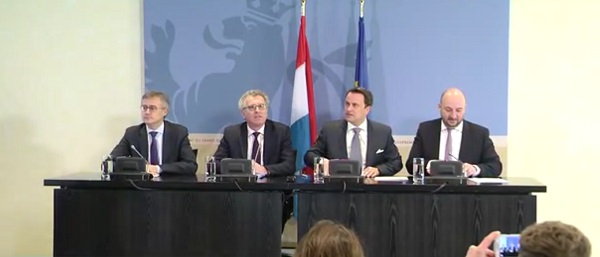
In one of the most anticipated legislative reforms of the current government's five-year term of office, details were revealed on Monday morning during a press conference streamed live from the Chateau de Senningen; the 2017 Tax Reform is expected to cost €400m - €500m.
Luxembourg's Prime Minister, Xavier Bettel, the Deputy Prime Minister and Minister for the Econony, Etienne Schneider, the Minister for Finance, Pierre Gramegna, and the Minister for Justice, Félix Braz, were the government representatives present, with PM Bettel introducing the changes and Minister Gramegna outlining the details and stressing that the changes need to respect the European Stability Pact. The overall cost to the state will be between €400 million and €500 million.
Personal Taxation
The government will abolish the 0.5% budgetary tax. Tax credits for low-income households have been doubled to €600 for those with an income between €11,265 to €40,000. Single-parent tax credits will double from €750 in 2016 to €1,500 in 2017. And from 2018, couples may choose to be taxed either individually or jointly.
The tax threshold of €45,897 has been risen to €49,793, with the 39% tax rate still applying. For those with an annual income between €150,000 and €200,000, a 41% rate will be applied, with a 42% rate on income in excess of €200,000.
Tax allowances of €3,200 will be introduced for those aged under 40 who choose to pay into an additional pension scheme. The same age group will receive home savings tax relief increased to €1,344 annually.
Corporate Taxation
Corporate tax rates will reduce from 21% to 19% in 2017 and to 18% in 2018.
Small and medium sized enterprises (SMEs - officially companies employing up to 250 staff and with a turnover of below €50m) will see corporate tax reduced from 20% to 15% if their taxable income is less than €25,000.
On sustainable travel, owners of zero-emission vehicles will benefit from a tax reduction. Tax provisions regarding company cars are being reviewed in order to promote the use of less polluting vehicles.
Conclusion
The changes are expected to come into force on 1 January 2017 provided, of course, they are approved beforehand by parliament. According to Statec, the average annual income in 2014 was circa €54,600.
The changes have been applied to achieve social equity, with the poorest and middle-income households to have their buying power considerably strengthened. "In the spirit of solidarity, those with the most revenue will have to contribute more."
In addition, the tax authorities will receive additional resources to clamp down on tax evasion.
Photo by Luxembourg Government (L-R: Félix Braz, Minister of Justice; Pierre Gramegna, Minister of Finance; Xavier Bettel, Prime Minister; Étienne Schneider, Minister of Justice)