 Credit: Ievgenii Karanov, Chronicle.lu
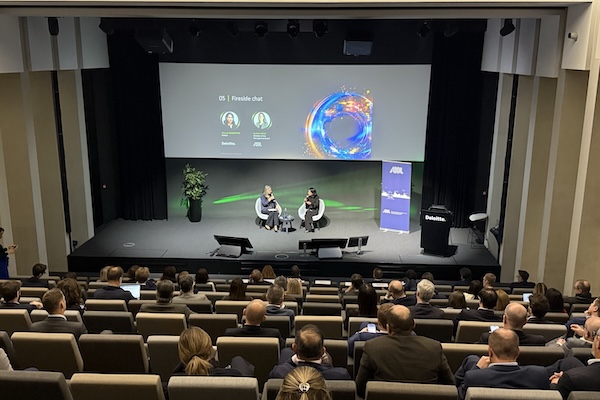
On Tuesday 9 December 2025, Deloitte Luxembourg held its “Banking 360° – The ExCo Agenda” conference, organised with the participation of the ABBL, at the firm’s premises in Luxembourg-Gasperich.
The event gathered over 80 professionals and key stakeholders, addressing the latest banking trends and developments while presenting hands-on approaches to operational efficiency and cost reduction and highlighting initiatives aimed at supporting banks in Luxembourg.
Deloitte Luxembourg Partner Pascal Martino opened the conference by inviting participants to reflect on the pace of change in the banking industry. “When was the last time you really felt excited about the future of our banking industry?” he asked, noting that shifts in client expectations, technology and competition had transformed the sector within just a few years. Pascal Martino emphasised that Luxembourg’s banking centre has the capabilities needed to respond to these developments, stating: “We are small enough to be agile and large enough to matter globally.” He highlighted Luxembourg’s expertise, talent and stability as key assets for future growth, adding that the central question is whether the industry will shape its own future or allow others to define it.
Deloitte Luxembourg Partner Justin Morel De Westgaver presented an overview of recent banking market trends, noting ongoing consolidation in Luxembourg’s banking sector, a stable workforce of around 26,000 employees and improving profitability driven by higher interest rates. He highlighted that net revenues grew by 14% between 2022 and 2024 while cost increases remained more moderate, resulting in an average return on equity of around 11%. Justin Morel De Westgaver also outlined performance differences across banking clusters and stressed the importance of data-driven benchmarking to guide strategic choices. “Banks need to stay alert to developing trends and make the right strategic choices to thrive in a competitive environment,” he said, pointing to revenue diversification, process optimisation, automation and enhanced workforce planning as key areas of focus.
Maxime Gaborieau, Director at Deloitte Luxembourg, then presented a live demonstration of Deloitte’s Bankview benchmarking solution, explaining how it helps institutions assess market positioning and identify performance drivers. He noted that the sector is shifting “from profitability to uncertainty”, with falling interest rates, rising costs and intensifying competition putting pressure on margins. Using benchmarking examples and scenario simulations, he illustrated how banks can evaluate cost structures, compare revenue evolution and forecast the impact of economic changes. Maxime Gaborieau emphasised that banks face a “double squeeze” of declining revenues and higher costs and must act decisively, highlighting priorities such as business growth, operational efficiency, digital and AI capabilities and workforce transformation.
Senior Managers Luis Ribeiro and Marie-Cécile Legrand of Deloitte Luxembourg discussed the strategic importance of cost transformation for banks, noting that while recent profitability has benefited from high interest rates, the sector now faces rising regulatory demands, growing operational costs and accelerating technological disruption. Luis Ribeiro emphasised that banks operating in Luxembourg’s high-cost environment must “future-proof their operations” by understanding their relative market position and prioritising optimisation initiatives ranging from tech-stack rationalisation and AI-enabled process improvements to more rigorous vendor management. He added that early digital investments are already translating into tangible efficiencies for institutions that have acted proactively.
Marie-Cécile Legrand highlighted the critical role of human capital in any transformation effort, stressing that banks “cannot transform what they do not understand”. She outlined how workforce analysis, strategic workforce planning and targeted upskilling, particularly in areas such as AI, cybersecurity, ESG and risk culture, are essential to ensuring banks have the capabilities needed for the future. Marie-Cécile Legrand noted that HR must act as a strategic partner in delivering long-term change, while Ribeiro underlined the importance of clear governance, realistic cost commitments and continuous communication of progress to embed a strong cost culture across organisations.
In a fireside discussion on how banks can differentiate and grow, Deloitte Partner Maryam Khabirpour and ABBL General Secretary Sandrine Roux explored the strengths and challenges of Luxembourg’s “uniquely diverse” banking sector. Sandrine Roux noted that the mix of private, corporate, retail and custodian banks, together with emerging payment institutions, creates a complementary ecosystem that is often taken for granted. She added that while dependence on foreign head offices may appear to be a vulnerability, it has in practice encouraged local stakeholders to continuously improve Luxembourg’s regulatory, tax and employment environment.
Sandrine Roux also addressed the sector’s current risk landscape, recalling that Luxembourg banks demonstrated strong resilience during recent geopolitical shocks, though “geopolitical and cyber risks” remain top concerns for chief risk officers. She identified opportunities ahead, including the development of long-term investment services, the upcoming wave of business successions across Europe and collaboration with new market entrants such as fintech and payment institutions. To prepare for future transformation, she stressed the need for greater diversity of skills at board level, stronger transversal governance and closer alignment between CFOs and senior management to support long-term strategic decision-making.
In his closing remarks, ABBL CEO Jerry Grbic stressed the need for the sector to navigate accelerating geopolitical, technological and talent-related pressures, calling the ABBL “a strategic tool to explain, promote and defend the role of our banking sector”. He warned that global deregulation, cyber risks and digital disruption were reshaping financial intermediation, adding that “cryptoassets, stablecoins and tokenisation are rewriting the architecture of finance”. Jerry Grbic highlighted Luxembourg’s strengths in stability, governance and cross-border expertise, but noted that demographic change and talent scarcity require sustained action. He reaffirmed the ABBL’s commitment to social dialogue and innovation, pointing to initiatives such as the FinTech and Innovation Forum and the new Strategic Innovation Cluster designed to coordinate sector-wide priorities.
The event concluded with a networking lunch.