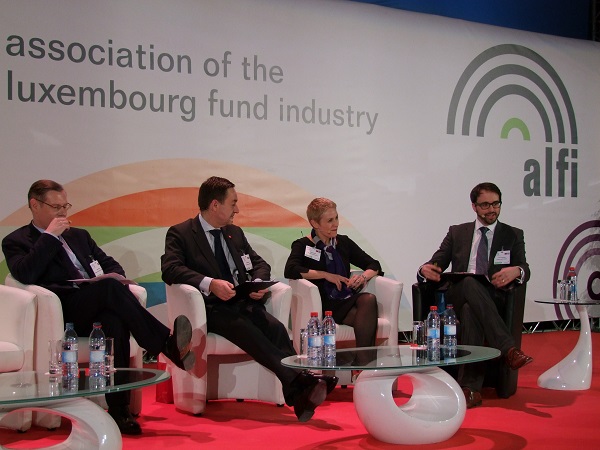
The Alternative Investment Fund Conference organised by ALFI, the Asscociation of the Luxembourg Fund Industry, is being held on Tuesday and Wednesday this week at the European Convention Centre in Luxembourg-Kirchberg.
On Tuesday afternoon one topic addressed was that of Nation Branding - does a country image matter? Tom Theobald, Deputy CEO at Luxembourg for Finance, interviewed a panel discussion including Sasha Baillie (Diplomatic Advisor and Deputy Chief of Cabinet of the Deputy Prime Minister at the Ministry of Economy of Luxembourg, and Chair of the Nation Branding Committee), Urs Hammer (Ambassador of Switzerland to Luxembourg) and Timo Ranta (Ambassador of Finland to Luxembourg and Belgium).
Sasha Baillie explained the reasoning behind Luxembourg's Nation Branding initiative, to achieve a coherent and consistent message. She said that the work involved including the whole society. They resorted to a methodology to establish the essence and core values of the country, which established key characteristics and profiles that are used in the marketing industry to create brands. They applied this methodology to cover the entire country, both Luxembourg nationals and non-national residents, as well as cross-border workers. One such characteristic that came out of this research was Creative; another was Ally. The methodology also organised a series of workshops at which further feedback was gathered. The results of this Nation Branding initiative will be started to roll-out shortly, with Luxembourg's Secretary of State to start it off with a toolbox format.
She said that a first perception of a country is very important, particularly in places where one is maybe not already known and the opportunity to create a first impression is limited and often short in time in which to convey instinctive and core values of a country.
Ambassador Ranta said that Finland started such a nation branding process in 2008 by initiating a Country Brand Delegation which was chaired by the former CEO of Nokia. The delegation organised summits involving international guests, as well as summits and an on-line public information gathering exercise, lasting over 2 years. A drafting team delivered a 370-pages report in 2010. He highlighted two main conclusions: (1) the focus must be concrete and (2) build on existing images (what people think of Finland already). There were 3 major strengths to describe Finland: functionality (Finland works, Finland can solve problems); beautiful nature and clean environment; an excellent education system. Subsequently, a series of missions were identified at three levels: individually, in a national framework and internationally. Currently there is a small team of 10 "running the show" including the Prime Minister, the CEO of Nokia and civil servants.
He added that a country brand is stable, compared to a corporate brand which may change and evolve; a country brand may just be tweaked.
Ambassador Hammer explained that Switzerland's Nation Branding exercise started in 2001. He referred to the issue of dormant bank accounts in the 1990s which led to Switzerland to examine its Nation Branding strategy which came from forming a Commission and creating an agency to promote Switzerland abroad which portrayed Switzerland's attractiveness. He explained that the focus was based on traditional, not modern, values, which have been very positive. A thematic approach on topics such as research and vocational training, with links to traditional values, is a political instrument of Switzerland's foreign policy.
He said that in 1991 Switzerland celebrated 700 years of existence; he admitted there are many differences in the country which is made up of 3 cultures and 3 languages - this emphasis on uniformity is very important.
The ALFI Alternative Investment Fund Conference continues on Wednesday.
Photo by Geoff Thompson (L-R): Ambassador Hammer of Switzerland; Ambassador Ranta of Finland; Sasha Baillie of Luxembourg's Ministry of Economy; Tom Theobald of Luxembourg for Finance