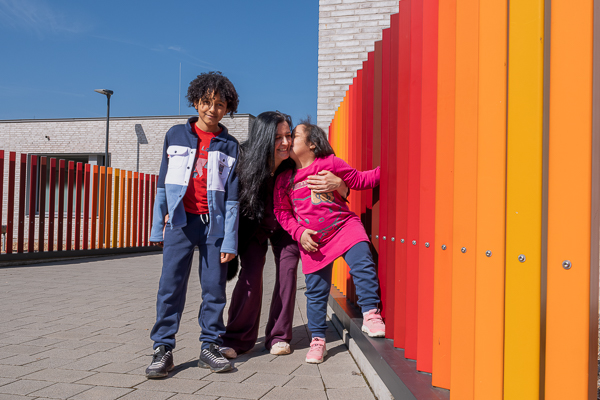
 Paula de Lacerda pictured with her children Henrique (left) and Beatriz (right);
Credit: Ali Sahib, Chronicle.lu
Paula de Lacerda pictured with her children Henrique (left) and Beatriz (right);
Credit: Ali Sahib, Chronicle.lu
On the occasion of World Down Syndrome Day, Chronicle.lu spoke with Paula de Lacerda, a Luxembourg-based mother of a child with trisomy 21, who recently became one of twelve members of the National Representation of Parents.
The 49-year-old woman has been living in Luxembourg for the past seven years, having moved from Portugal during her second pregnancy, with her two-year-old son, in search of a safer and more stable environment for her children. “I came to Luxembourg without knowing anyone,” she recalled. “I just came with the certainty that things would work out, because I wanted to protect my children.” She explained that her decision to leave was driven by difficult family circumstances, adding that Luxembourg stood out as a multicultural and family-oriented country where her children could grow up feeling accepted.
During her pregnancy, Paula learned she was expecting twins. A medical examination later revealed that one of the babies had trisomy 21. “My baby is going to be loved no matter what,” she said, recalling her initial reaction to medical recommendations for further testing. Following additional examinations, the diagnosis was confirmed, and she was presented with options, including the possibility of terminating the pregnancy. “For me, that was never an option,” she said. “All life is sacred.”
She emphasised that the diagnosis did not change her perception of her child: “For me, it is just one more chromosome. Some people say ‘extra chromosome, extra cute’, I say ‘extra love’.” One of the twins, Laura, passed away shortly after birth following medical complications, a period Paula described as challenging but also deeply meaningful.
Reflecting on her experience, she said her approach to raising her daughter Beatriz has always been guided by a sense of normality and acceptance. “It was never an issue at home,” she shared. “She is just my daughter.”
Paula’s outlook on life has been shaped by a diverse personal background. Born in Mozambique, she moved to Portugal as an infant due to the civil war, before later living and working in the United States as an architect and eventually returning to Mozambique for several years. Reflecting on these experiences, she said they helped her develop a flexible and positive perspective. “At every moment, I can choose to focus on what is missing or to be grateful for what is going well,” she explained, adding that during difficult periods she would take things “fifteen minutes at a time”.
This mindset has also influenced how Paula approaches raising her daughter. She recalled a moment that shaped her perspective, when Beatriz was around six months old and she met a man from Sudan who described children with trisomy 21 as a “gift”. “He told me that in his country, families may even pray to have a child with an extra chromosome,” she said, adding that such children are seen as something special, bringing people together. Paula noted that this perspective reinforced her own approach: “If we believe that a child is limited, the result will reflect that belief. For me, I just need to respect Beatriz’s timing and allow her to develop in her own way.”
In practice, Paula said she prioritised a supportive and caring environment over specialised approaches. While Beatriz attended recommended therapies, one specialist later advised that additional sessions were unnecessary. “She told me, ‘your daughter does not need to come here’,” Paula recalled, noting that the therapist recognised her daughter’s abilities beyond the diagnosis. She added that her daughter has been integrated into mainstream childcare and schooling in Luxembourg, where she has generally encountered understanding and support. “I have mostly experienced kindness,” she said, adding that some parents had expressed appreciation for the opportunity for their children to grow up alongside Beatriz. At home, she has always avoided defining her daughter by her condition: “We never made it a topic. She is just part of the family.”
Paula said her experience has also shaped her views on inclusion in education. Now elected to Luxembourg’s National Representation of Parents, she said she wants to help ensure that children with trisomy 21 and other special educational needs are heard and supported within the mainstream system. “I really want to contribute to the voice of my child to be heard - and not only Beatriz, but all the children,” she said. “I really believe that inclusion is the way.”
She explained that, from the time Beatriz entered school in Luxembourg, she was informed about the possibility of attending a specialised educational setting, the Centre for Intellectual Development (Centre pour le développement intellectuel - CDI), where smaller class sizes allow for more individual support. However, Paula said she felt strongly that her daughter should remain integrated with other children. “My heart told me no,” she recalled. “I believe integration needs to happen every day, not after years of separation.”
According to Paula, Luxembourg’s school system does provide support for children with special educational needs within mainstream education, including regular follow-up meetings and access to specialists where needed. However, she believes more could be done to strengthen inclusive support in practice.
Paula pointed to everyday school life as proof that integration can work. Recalling a school performance, she said she unexpectedly saw Beatriz on stage taking part in a theatre piece alongside other children. “She was very concentrated, doing her role really nicely,” she recalled, describing the moment as “beautiful to see”.
She also stressed that education goes beyond academic achievement, highlighting the importance of belonging, identity and helping each child recognise their own value. In her view, Luxembourg’s multicultural environment offers a strong foundation for this approach. “The way we support children today will shape how they contribute to society tomorrow,” she added.
Reflecting on her journey, Paula said her experience has been guided by a focus on acceptance rather than fear. “We can choose to see limitations, or we can choose to see potential.”