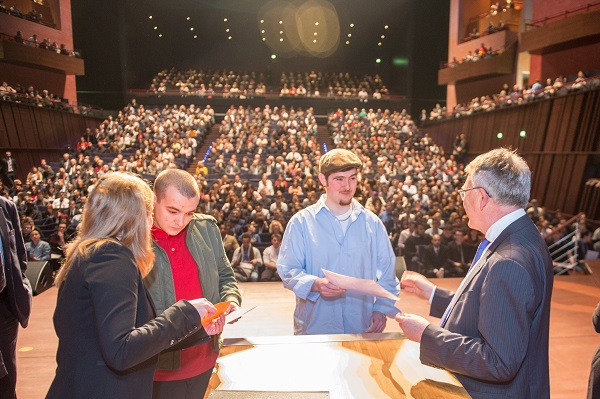
On Sunday 21 February, a total of 649 apprentices across a variety of trades received their diplomas and certificates at a graduate event at the Philharmonie in Luxembourg-Kirchberg.
The event was organised by the Chambre de Commerce, the Chambre des Salariés and the Ministry of National Education, Children and Youth, for apprentices in trade, industry, hotel and catering, services and socio-educational, in the presence of Claude Meisch, Minister for Education, Children and Youth. and Nicolas Schmit, Minister of Labour, Employment. Social Economy and Solidarity.
The cereomony also included 82 certificates of "Promotion of Work", whichrewarded apprentices who distinguished themselves through special efforts.
Such vocational training courses have be set up to bridge the gap between the school world and the economic world, including the support of organisations which have offered plaxces for apprentices.
In his welcome address, Carlo Thelen, CEO of the Chamber of Commerce, welcomed the encouraging results of the 2015 academic year and revealed a success rate of 85.42% from more than 900 new apprenticeship contracts. On the other hand, some apprentice positions remoaned vacant while other young people were left without apprenticeships; this was due partly to sometimes young people not having the required entry-level education needed.
The President of the Chambre des Salariés (CSL), Jean-Claude Reding, congratulated the winners and emphasised the importance of a degree to fit into the workforce. He recalled that the training has been, since 1929, an essential pillar of the Luxembourg education system. He emphasised the need to improve or create new devices facilitating access to the graduate training of employees.
To solve the dysfunctions which persist in vocational training, Mr. Reding stressed the importance of establishing a dialogue between all stakeholders. Avoid a hasty implementation of the reform of the law on vocational training in order not to repeat the mistakes of the past. The CSL suggests a holistic approach in order to have an overview of schooling and suggests a radical reform of the lower cycle of secondary technical education, the origin of some problems for vocational training. In conclusion, Jean-Claude Reding stressed the need to make every effort to continue to improve the quality and attractiveness of vocational training and wished every success to the winners throughout their professional and personal lives.
The presentation of final apprenticeship diplomas was also an opportunity for the Chambre de Commerce and the Chambre des Salariés to offer a training voucher to all graduates.
Claude Meisch, Minister for Education, Children and Youth, thanked stakeholders - professional associations, colleges and business trainers - for their role towards the successful implementation of the professional training reform.
Nicolas Schmit, Minister of Labour, Employment. Social Economy and Solidarity, presented the "Promotion of Work" certificates to the 82 graduates who excelled during training and achieved outstanding results. The Minister welcomed the excellent results of this promotion and said that the share of young people who found employment was higher among those with a professional degree than in students without a degree, before concluding that training remains the best weapon against youth unemployment.