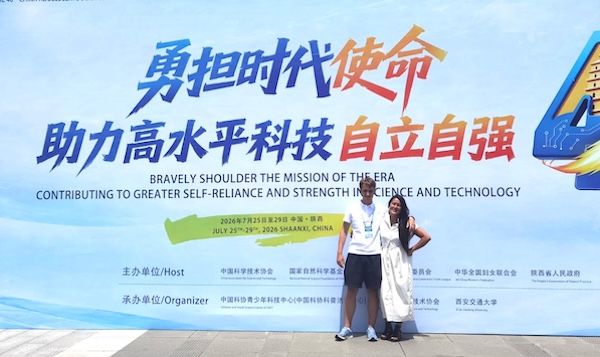
 (L-R) Maxim Lebedev, Luxembourgish student; n/a;
Credit: FJSL
(L-R) Maxim Lebedev, Luxembourgish student; n/a;
Credit: FJSL
The Fondation Jeunes Scientifiques Luxembourg (FJSL) has announced that eighteen-year-old Luxembourgish student Maxim Lebedev has won the UNISOC Innovation Award at the 40th National Youth Science and Technology Innovation Competition (CASTIC), China's largest youth science competition, held in Xi'an, Shaanxi Province.
The competition, which concluded on Wednesday 29 July 2026, brought together several hundred participants from across China, as well as 83 international participants from 27 countries representing every continent.
The FJSL noted that, with the support of the Fondation Nicolas et Jean-Paul Lanners, it has been sending a laureate of the National Jonk Fuerscher Contest (NJFC) to CASTIC for almost fifteen years.
According to the foundation, Maxim Lebedev's award marks the culmination of a long journey with FJSL. A five-time participant in the NJFC, he first joined the foundation's programmes at the age of eleven after winning two Science Trips. He later took part in the Mobisciences programme in Toulouse and the Mathematics Summer Camp in Bulgaria, experiences which helped develop his scientific skills and ultimately led to his participation at CASTIC.
Maxim Lebedev represented Luxembourg with his project named "Adaptive Urban Traffic Analysis: A Simulation of Traffic Congestion within and around Luxembourg City". It uses an agent-based simulation based on real population, demographic and commuting data, combined with OpenStreetMap road information, to model traffic flows in and around Luxembourg City. According to the foundation, the simulation successfully reproduced real congestion patterns observed on Google Maps and could one day help identify issues such as inefficient traffic light cycles and overloaded roads.
Reflecting on the experience, Maxim Lebedev said: "While CASTIC is a high level and quite competitive event, as a participant you rarely feel like you're competing against other students. Instead, you feel like you are facing the tasks as a big group. Both team and individual tasks felt like fantastic tests of our skills, abilities and improvisation capabilities, while the discussions and anticipation centred around the tasks led to further bonding with both international and Chinese participants. Events such as the cultural exchange evening and the several visits to popular Xi'an sites were an amazing way of learning other cultures, while still remaining in a scientific sphere of interest. The only downside of CASTIC that comes into my mind is the fact that it ended so soon."
Sousana Eang, CEO of the FJSL, added: "There is something deeply moving about seeing a young person reveal their potential over time. Maxim's distinction is the result of his own curiosity, perseverance and hard work. Being here in Xi'an to witness this moment makes me immensely proud - of him, of how far he has come, and of the brilliant young scientist he is becoming."
The foundation also highlighted its long-standing partnership with CASTIC. Since an official agreement was signed in 2018, the Luxembourg International Science Expo (LISE) award has become an official CASTIC prize. This year, the FJSL presented the LISE award to five students from Australia, Cambodia, China, Thailand and Vietnam, who will be invited to participate in the next edition of LISE.
The Luxembourg International Science Expo 2026 will take place from 18 to 24 October 2026, with its public exhibition hosted at Lycée Vauban in Luxembourg-Gasperich on 22 and 23 October 2026. The event will be free of charge.