Following the agreement on the emergency relocation of 120,000 refugees across EU Member States last week, the Luxembourg Minister of Health, Lydia Mutsch, yesterday emphasised the importance of providing medical, social and psychological care for these refugees.
The current refugee crisis has seen the greatest displacement of people since the Second World War, with nearly half of these uprooted people, almost 60 million, being children. Faced with this influx, the EU Member States have been called on to show solidarity, with Minister of Foreign and European Affairs, Jean Asselborn, previously stating that "it cannot be a national solution, but only a European one".
The point was yesterday reiterated by Minister of Health Lydia Mutsch, who declared "We must not miss the opportunity to cooperate in order to achieve a sound and responsible migration policy, by addressing all the dimensions of this crisis and being respectful of our common values!"
It is certainly conceivable that this mass migration will have an impact on the health systems of Member States, indicating that adequate health policies must be put in place. The Health Minister emphasised the importance of equal access to healthcare for refugees and migrants, such as medical examinations, vaccinations and emergency healthcare. She went on to state the necessity of strengthening the capacity of health care infrastructure in order to better manage the refugee flow.
"An international protection seeker, arriving in Europe after a long journey, is not only in need of housing, but also adequate health and medical treatment," the Minister explained. Currently, a medical examination is given to each new arrival of a displaced person upon arrival in Luxembourg at the Health Center and the Sanitary Inspection Division of the Ministry of Health. If necessary, the Luxembourg Office for Reception and Immigration (OLAI) also organises the medical supervision of refugees by helping them book appointments with specialist doctors with the aid of an interpreter.
At the present time, fifty people are examined a week, or around 200 a month, with Minister Mustch assuring: "Our services are well prepared and can still accommodate more refugees with current means." The Health Department has also been authorised to recruit staff reinforcements through the 2016 budget, as well as two additional specialists, in order to ensure the medical and psychological evaluation of new arrivals.
"It is close to my heart that, on the one hand, the international protection seekers who we receive, receive the healthcare that they need, and on the other, that we reduce the risk of the spread of infectious diseases to a minimum," the Minister continued. "The protection of public health is indeed one of our key missions".
The Health Inspectorate was established in this regard in May 2012, in collaboration with the OLAI, as means of detecting through health checks potential carriers of infectious diseases. This health check currently consists of a medical examination, a chest X-ray, a skin and blood test, and a stool examination. Vaccinations are also made available to refugees, with almost all people vaccinated upon entrance into the country.
"The vast majority of migrants arrive in a very good state of physical health," reported Dr. Peter Weicherding, Head Physician of the Health Inspectorate. "Screening tests are used to see the infectious agents in a small number of people, which are not externally visible or are non-active. In this case, the health problem is rapidly eliminated and the person concerned no longer poses any risk to public health".
Psychological care is also a major factor in helping refugees, who often arrive in the Grand Duchy having witnessed violence or undergone traumatic experiences. As a result, some suffer from psychological problems and need professional support in this area.
"We are aware that our current healthcare system is not yet sufficiently prepared to support a large number of refugees who have suffered psychological trauma," admitted Dr. Juliana D'Alimonte, psychiatrist and Manager of the Socio-therapeutic Action Service of the Health Directorate. "Nevertheless, we are putting the necessary means in place to ensure appropriate therapeutic management".
The Ministry of Health reported that a first step lay in fully understanding the nature of the psychological issues suffered by the refugees, in order to establish focused action.
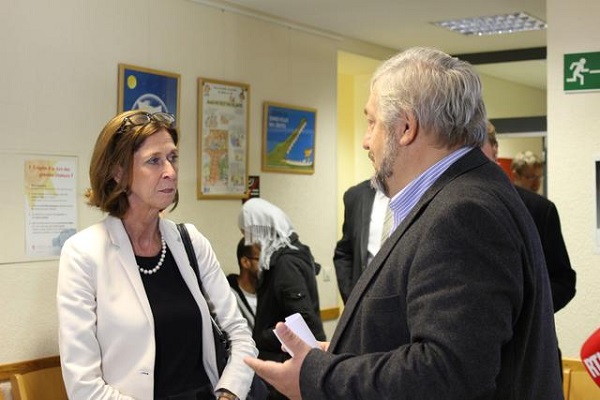
Photo by Ministry of Health (L-R: Minister of Health, Lydia Mutsch; Secretary General of the Ligue Médico-Sociale, Jean Rodesch)