On 1 January 2015, Luxembourg introduced new VAT rates in an attempt to increase the state's VAT revenue to compensate for the loss of VAT from eCommerce arising out of the european Parliament's ruling that such VAt should from then be charged by the country of destination, not the country of origin.
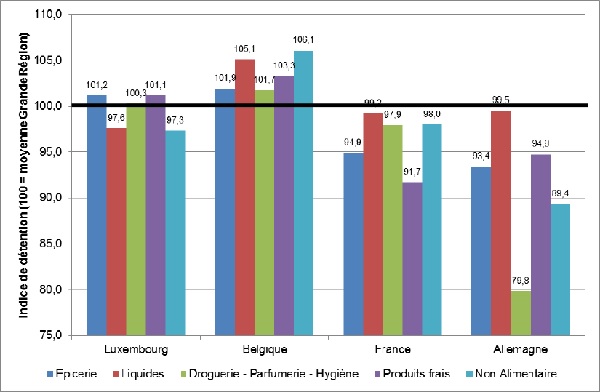
At a press conference on Monday, Luxembourg's Secretary of State for the Economy, Francine Closener, presented a study of the Observatory of Price Formation entitled "Analysis of the level and the evolution of prices of consumer products in Luxembourg and the Greater Region". On the basis of price surveys conducted in November 2014 and February 2015, the study compares the prices of identical products strictly in a sample of food supermarkets in the Greater Region (Luxembourg, Lorraine, Rhineland Palatinate and Wallonia).
The price comparison of these surveys conducted using 6 different brands in Luxembourg before and after the rise of different VAT rates on 1 January 2015 reveals that the VAT rise seems to have had only a small impact on the prices observed concerning large product consumption in Luxembourg. The products available in the two surveys in November 2014 and February 2015 show an average global price increase of 0.43% in Luxembourg.
Secretary of State Closener said "According to the study, a quarter of the products subject to the standard VAT rates have seen lower prices between late 2014 and early 2015, and about a third of the products have not changed their final prices, despite the rise in VAT. So less than half of the products directly affected by the VAT increase have actually seen their prices revised up in February 2015 compared to November 2014."
Overall, the slight rise in prices seen in Luxembourg between November 2014 and February 2015 is significantly below the theoretical impact of an integral transmission on consumer prices of the increase in VAT by 2 percentage points. If a full transmission of the VAT increase in consumer prices, prices have increased globally by an average of 0.62%.
It is important to consider that higher final prices observed between the period of November 2014 and February 2015 does not necessarily result solely from higher VAT rates. Other factors may also play a role, as higher raw materials, labour costs, rent or price increases for intermediate players (suppliers). It is also useful to note that about two thirds of the products of the database used in this report are subject to the super-reduced rate of 3%, which remained fixed.