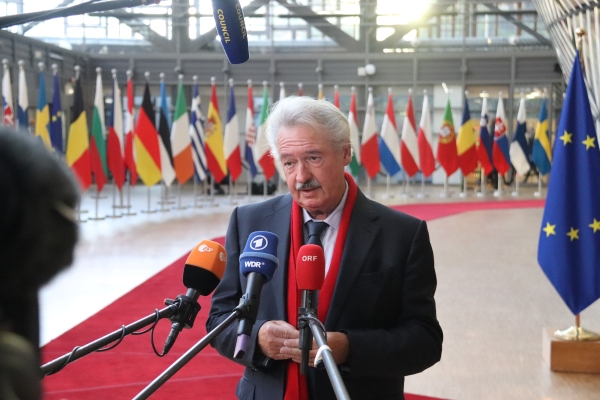
 Jean Asselborn, Minister of Foreign and European Affairs, in Brussels on 14 November 2022.;
Credit: MAEE
Jean Asselborn, Minister of Foreign and European Affairs, in Brussels on 14 November 2022.;
Credit: MAEE
On Monday 14 November 2022, Luxembourg's Minister of Foreign and European Affairs, Jean Asselborn, participated in the meeting of the European Union (EU) Foreign Affairs Council.
The meeting began with the adoption of conclusions on the “Women, Peace and Security” (WPS) agenda. While welcoming the continued efforts to strengthen the WPS agenda worldwide, Minister Asselborn pointed out, in his intervention on behalf of the Benelux countries, that: "The EU must do more to deal with the growing pressure on space citizenship and the serious setback to the full, equal and meaningful participation of women and girls in all areas of political and economic life”. After emphasising that the EU must continue to develop and implement policies, activities and advocacy to form a united front on this important subject, Minister Asselborn pointed out that sexual and gender-based violence is one of the most widespread, persistent and devastating human rights violations.
Subsequently, after being briefed via video-teleconference by their Ukrainian counterpart on the latest developments on the ground in Ukraine, the Foreign Ministers had an in-depth discussion on issues related to the Russian war of aggression against Ukraine. In this context, Minister Asselborn underlined the importance for the EU to remain united and to maintain its support for Ukraine, particularly in view of the winter. He also stressed that it is essential that the grain agreement can continue and be extended when it expires in a few days. The Secretary General of the United Nations, Antonio Guterres, can count on the unfailing support of Luxembourg in his efforts in this regard.
Subsequently, the ministers had an exchange of views on the Great Lakes region. Minister Asselborn expressed Luxembourg's great concern over developments in this region, which alongside the Sahel and the Horn of Africa, constitutes another powder keg on the African continent.
Faced with the persistent conflict in the east of the Democratic Republic of Congo, which remains one of the worst humanitarian crises in the world, Minister Asselborn stressed the need to keep the channels of dialogue open and to work for transparency, de-escalation and regional cooperation. In this very worrying context, Luxembourg welcomes the development of a new EU strategy on the Great Lakes region; strategy which emphasises a political process based on a common approach to regional conflict resolution, but which also includes national reconciliation within the different countries of the region.
Ministers then discussed the situation in the Western Balkans, including the latest developments related to the dialogue between Belgrade and Pristina. The situations in Montenegro and Bosnia and Herzegovina were also mentioned, as was the need for partners in the region to align themselves with the common foreign and security policy as well as the visa policy of the EU.
Finally, the day was closed with a discussion on current European and international issues, including the situation in Iran and the latest developments in Lebanon. Luxembourg expressed its full solidarity with the Iranian women and men who risk their lives by demonstrating for the respect of their human rights and their desire for freedom. Faced with the brutal repression carried out by the Iranian regime against its own population, Luxembourg welcomes the adoption by the EU today of additional sanctions against 29 individuals and three entities implicated in serious human rights violations in Iran.