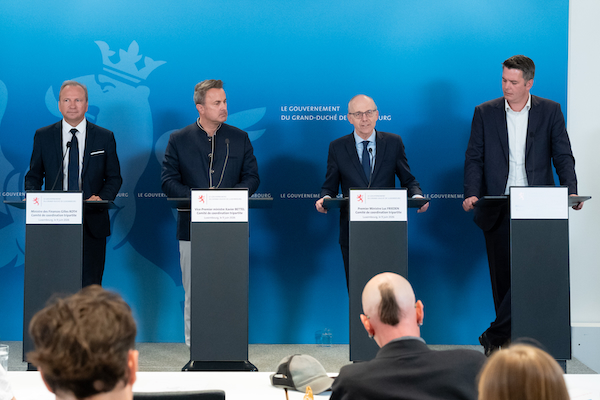
 (L-R) Gilles Roth, Minister of Finance; Xavier Bettel, Deputy Prime Minister, Minister of Foreign Affairs and Foreign Trade; Luc Frieden, Prime Minister; Lex Delles, Minister of the Economy, SMEs, Energy and Tourism;
Credit: © SIP / Emmanuel Claude
(L-R) Gilles Roth, Minister of Finance; Xavier Bettel, Deputy Prime Minister, Minister of Foreign Affairs and Foreign Trade; Luc Frieden, Prime Minister; Lex Delles, Minister of the Economy, SMEs, Energy and Tourism;
Credit: © SIP / Emmanuel Claude
On Tuesday 9 June 2026, Luxembourg Prime Minister Luc Frieden held a press conference at the Hôtel Saint-Augustin in Luxembourg-Ville, following the signing of the agreement of the Tripartite Coordination Committee on Monday 8 June,
Prime Minister Frieden was joined at the press conference by Deputy Prime Minister, Minister of Foreign Affairs and Foreign Trade, Xavier Bettel, Minister of the Economy, SMEs, Energy and Tourism, Lex Delles, and Minister of Finance, Gilles Roth.
Prime Minister Frieden began by stating that he was “extremely satisfied to have been able to find an agreement after intense discussions” and stressed “we wanted to find an agreement so that this crisis, which was launched by the war in Iran and its consequences in the Gulf region, so that it does not have a great impact on the population, on companies, on the country”.
The Prime Minister continued by thanking those who participated in the tripartite discussions and noted that it was not an easy process for those involved but he reiterated was happy to have been able lead his first discussions of this type and that the talks succeeded primarily because of the efforts of those involved.
He remarked: “We all want that the people of the country can be protected and for what we have achieved in the two and a half years of this government, we do not want it to be destroyed. So we have achieved three objectives. First of all, to slow inflation and strengthen purchasing power. Secondly, to protect companies and jobs. And thirdly, to ensure the transition to renewable energies so as not to be dependent on fossil energies that come from other places very far in the world.”
Minister Bettel then spoke of the significance of the agreement for the country. He said: “It is a success for Luxembourg, it is a success for our country, it is a success for the government, it is a success for social partners, it is a success for this government. I have been cooperating with it for ten years. When there is a tripartite, we hope that there is an agreement at the end, but it is never guaranteed in advance.”
He added: “What was important was that we did not want to do something only for one and not for the other. So we are trying to see how we can strengthen our economy on the one hand, our citizens on the other.”
On often contentious subject of housing and the rising costs in Luxembourg, Minister Bettel emphasised “we have to look for other solutions, there is no magic wand”; however, he emphasised: “The responsibility that we have is not only the responsibility of today, but also the responsibility of the future. For the next three years, we must have something, and we are not going to promise wonders in the tripartite to find out that afterwards [for example] there will be no more money for hospitals.”
Minister Roth began his speech by highlighting that “the tripartite is an investment for the co-habitation between the country and the population” before detailing that the cost of the measures agreed in the tripartite agreement will see cost rises for 2026 of €180 million, including €110 million of expenses that will end at the end of the year. For 2027, the estimated impact on the budget rises to €250 million. in a show of confidence, the minister added: “We have the necessary financial margins to finance these measures.”
On the impact of the additional strain on the budget, Minister Roth remarked: “Our investments will remain very high and overall the tripartite also corresponds to a large part of our life in common and our Luxembourgish model and social peace in Luxembourg will be guaranteed for the future of our country.
He added: “The population will therefore have more net income compared to the gross and what is the concrete allocation due to the credit of the sub-tax that has been introduced and which will be effective from 1 June for everyone, for all taxpayers of the country and not only for employees but also for pensioners and also for people who have commercial activities.”
In closing Minister Roth stated: “It is an investment in our life in common for the future and we are of the opinion that only with a strong economy we will have a strong social state and this is what we wanted to obtain with social partners thanks to these measures.”
Minister Delles turned to the issues of rising energy costs and the need to transition away from reliance on fossil fuels. He stressed: “People need to get out of dependence, to move away from oil and gas, to switch to electricity. Because there, as a sovereign country, we have other possibilities to extend green energy. And it is also a reality that there are still a lot of households that have heating with fuel or gas.”
He then detailed that in agreement with the government’s social partners, there will be a reduction of 4 cents per kWh of electricity from August to December 2026, in addition to the subsidy of the network fees that have been in effect since the beginning of 2026. In addition, there will be the compensation mechanism, so that subsidies of 4 cents plus those in effect make a total of 11.3 cents per kWh. there will also be a reduction of 15 cents per cubic meter of gas from August to December 2026, in addition to the network fees.
Minister Delles detailed that these measures, along with others in the agreement, including a reduction of 5 cents per litre of gasoline and diesel from July to December 2026, will cost approximately €65 million euros to implement.
He said: “Thanks to these aids related to energy prices, we strengthen the purchasing power of citizens, we provide more visibility, security and planning to companies and thus help to preserve jobs. All this without compromising our climatic objectives or our energy supply security.”
On the impact to Luxembourg’s agricultural economy, Prime Minister Frieden added: “We know that agriculture is greatly impacted by this tripartite, because the costs of wages and energy, but they also have costs to pay, that of increasing the prices of fertilisers…And for this reason, we have taken special measures in a European framework to come to the aid of farmers, to have support for the farmers. There are a few other agreements in favour of farmers. We want to help agriculture, but also the production of food in Luxembourg. It is a question of sovereignty, to be less dependent. We can produce certain things in Luxembourg, and we must encourage this national production. And we want to support agriculture. These meetings were important, and it was the first time in many years that agriculture was also invited to the tripartite.”