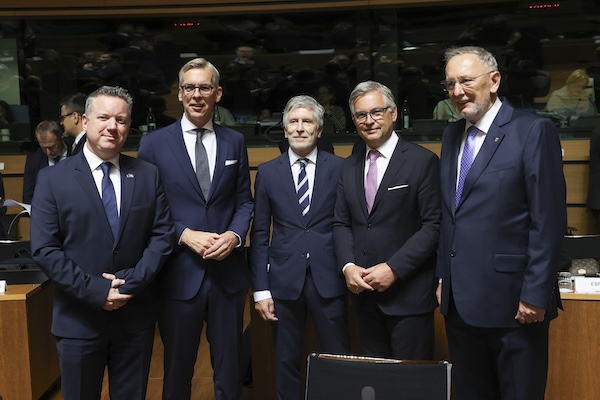
 (L-R) Gábor Pósfai, Hungary's Minister; Léon Gloden, Minister for Home Affairs; Fernando Grande-Marlaska, Spain's Minister; Magnus Brunner, European Commissioner for Internal Affairs and Migration; and Branko Zlobko, Slovenia's Minister;
Credit: European Union
(L-R) Gábor Pósfai, Hungary's Minister; Léon Gloden, Minister for Home Affairs; Fernando Grande-Marlaska, Spain's Minister; Magnus Brunner, European Commissioner for Internal Affairs and Migration; and Branko Zlobko, Slovenia's Minister;
Credit: European Union
On Thursday 4 June 2026, Luxembourg’s Interior Ministry announced that it took part in the European Union's (EU) Justice and Home Affairs (JHA) Council meeting.
Luxembourg’s Interior Minister Léon Gloden represented Luxembourg at the meeting, where ministers discussed migration, border management and internal security.
According to the ministry, during the Schengen Council session, European Commissioner Magnus Brunner welcomed progress in strengthening the EU's external borders, noting that migration pressure had decreased by 26%. The European Commission also announced new legislative proposals for the second half of the year to reform the mandate of the European Border and Coast Guard Agency (Frontex) and to introduce the digitalisation of return procedures. Commissioner Brunner described Schengen as one of the EU's greatest achievements, calling it "a resilient area that guarantees the security of its citizens."
Minister Gloden welcomed the Commission's opinions on the necessity and proportionality of internal border controls but expressed regret that there is "no clear deadline for the definitive removal of these controls," stated the ministry, adding that several other Member States also shared this view.
Regarding legislative files, the Presidency confirmed the agreement negotiated with the European Parliament (EP) on the Return Regulation. The regulation will enter into force following its publication in the Official Journal of the EU. However, provisions requiring significant implementation at national level will only apply one year later.
The ministers reviewed migration pressure in the English Channel and exchanged views on Somalia's cooperation in the area of readmission.
During the working lunch, ministers discussed extending temporary protection for Ukrainians fleeing Russia's war of aggression until March 2028. The Commission proposed limiting the personal scope of the protection scheme by excluding men of military age who are not authorised to leave Ukrainian territory. The Cypriot Presidency consulted ministers on their willingness to support this approach, the ministry said.
Minister Gloden stressed that "solidarity remains a fundamental pillar of our support for Ukraine. By maintaining a unified approach and avoiding any form of secondary movements, the European Union must continue to offer temporary protection to people affected by Russian aggression".
A large majority of Member States, including Luxembourg, expressed openness to the European Commission's initiative to extend the current protection regime while limiting its scope to exclude individuals of mobilisation age in Ukraine. The Commission is working closely with the Ukrainian government to develop this approach.
According to the ministry, under its right of initiative, the Commission must now table a formal proposal.
The afternoon session focused on internal security matters. Ministers held an exchange of views on the implications of the conflict in the Middle East for the EU's internal security. They also received an update on ongoing work to equip the EU with a comprehensive security strategy.