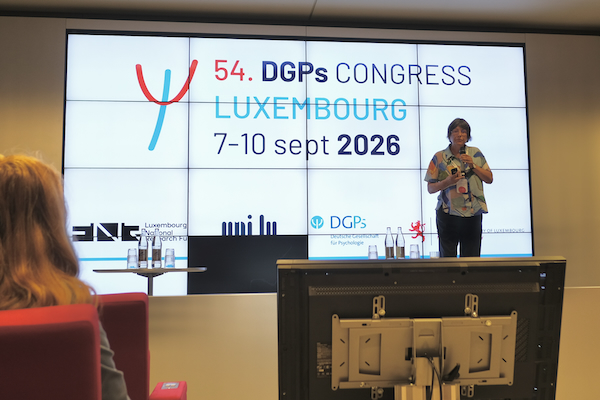
 Yvonne Rogers, psychologist and computer scientist;
Credit: Steven Miller, Chronicle.lu
Yvonne Rogers, psychologist and computer scientist;
Credit: Steven Miller, Chronicle.lu
On Tuesday 8 September 2026, Chronicle.lu attended day two of the four-day DGPs 54th international congress at the European Convention Centre in Luxembourg-Kirchberg.
The second day of the four-day event, hosted by the main professional association representing psychologists working in academic research and teaching in Germany - Die Deutsche Gesellschaft für Psychologie e.V. (DGPs), featured a number of seminars, panel discussions and keynote talks on subjects relating to psychology, mental health, biology and technology.
Chronicle.lu attended one of the headline events: “Out of Our Minds: What is AI Doing to Us and for Us?”, a keynote speech from Yvonne Rogers from University College London which focused on the impacts of artificial intelligence (AI) on the human mind.
Yvonne Rogers is a British psychologist and computer scientist who has more than three decades of experience and has helped shape the field of human-computer interaction with her pioneering work establishing ubiquitous computing through to her work today on human-centred AI. She has authored or contributed to more than 350 publications and her book Interaction Design: Beyond Human-Computer Interaction has sold more than 300,000 copies worldwide.
During her presentation, Yvonne Rogers detailed the process of “cognitive offloading”, providing a variety of examples of how humans offload computational processing by transferring information to an external medium e.g. transferring the process of remembering specific items to a shopping list, rearranging physical Scrabble tiles instead of performing the task mentally, shuffling playing cards into a particular order to understand their value.
Yvonne Rogers then detailed how this process has progressed to using software, such as spreadsheet applications, to shift the mental burden, and today sees us utilising generative-AI to perform similar, if not more, tasks in a similar fashion. Her perspective, however, is not how such software can help humans do less but how it can be designed and utilised to allow us to do more.
The computer scientist asked that if we offload ever more of the cognitive work onto AI, knowing that it can do these tasks for us and we have more free time, can we be more creative? What are the other things we will be freed to do? And posited the question: If we are not doing all that drudgery what will we become? Lazy, bored and dissatisfied?
This then led into the subject of the paradox of effort - the psychological contradiction where humans naturally avoid hard work because it feels costly, yet simultaneously seek out and value things more when they require hard work - and raised the question: Should we continue to design AI tools to reduce human effort or should we design AI tools to increase human effort?
Yvonne Rogers highlighted that fundamentally, AI is changing how humans perform tasks. She remarked: “We are thinking about what we want at the end rather than the process by which to get to it.”
The presentation featured an example of a study which utilised a trading tool called TradeBot which features an AI chatbot designed to promote short interactions with users. The participants had to make investing decisions, buying or selling stock, thinking aloud and then undergoing in-depth interviews. The key findings were that the chatbot made the participants re-evaluate their thoughts by helping the participants to reason about their intentions and to describe the rationale behind their decisions. This enabled them to reflect on their intentions and their goals. A stark contrast to the off-the-shelf generative AI platforms which provide direct answers when prompted.
The presentation then progressed to how such tools can be used collaboratively in the real world. “We work in teams and we work in organisations. How might we think about how to use AI to support our collective minds? So much of the work that has been done in the last few years has been on how AI tools can support individual minds. I think in the next few years we will see a shift in thinking about how they can be designed to support collaboration, collaborative working and particularly the sorts of meetings and collaborative tasks that we do regularly,” noted Yvonne Rogers.
In closing, Yvonne Rogers stated: “I think it is important at times, not always, that we slow down our thinking to encourage us to reflect a bit on what we are doing and why we are doing it.”