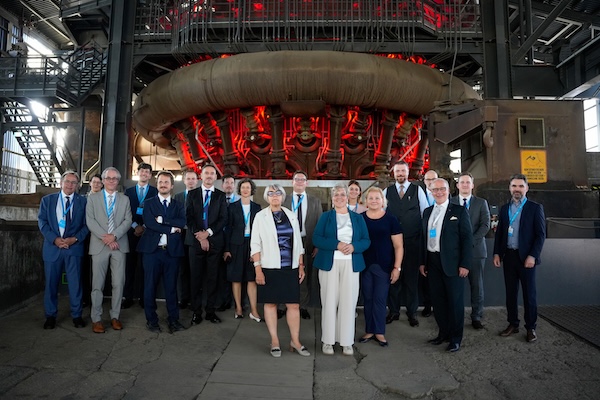
 Credit: M3S
From Monday 7 to Tuesday 8 September 2026, Luxembourg hosted the “Quintet of Health and Social Security”, bringing together ministers and senior officials from several German-speaking countries.
According to Luxembourg's Ministry of Health and Social Security, the main focus of the quintet was the modernisation of the pension system, health prevention and the fight against neurodegenerative diseases. The meeting, held at the invitation of Luxembourg's Minister for Health and Social Security, Martine Deprez, was attended by Elisabeth Baume-Schneider, Federal Councillor of the Federal Department of Home Affairs in Switzerland; Korinna Schumann, Federal Minister of Labour, Social Affairs, Health, Care and Consumer Protection in Austria; Dr Emanuel Schädler, Government Councillor of the Ministry of Society and Justice in Liechtenstein; Lilian Tschan, State Secretary at the Federal Ministry of Labour and Social Affairs in Germany; and Dr Georg Kippels, Parliamentary State Secretary at the Federal Ministry of Health in Germany.
“As host, I greatly appreciated the open exchange with my colleagues. Together, we reflected on the future of our health and social systems and on the challenges that connect us across borders,” said Minister Deprez.
Modernising and making pension systems more flexible
The ageing of the population in German-speaking countries, and more broadly across Europe, is placing increasing pressure on social security systems. Changes in the world of work, including digitalisation and artificial intelligence, as well as younger generations' desire to organise their professional lives more flexibly, are creating new challenges, particularly for pension systems.
The ministry noted that retirees are also seeking a smoother transition from working life to retirement, while an increasing number wish to remain partially professionally active.
The participating countries exchanged views on ways to ensure that pension systems remain financially sustainable, while also adapting them to these developments in order to maintain confidence in social security systems and preserve solidarity between generations.
Minister Deprez shared Luxembourg's experience with the “Schwätz mat!” consultation process. According to the ministry, this showed that reforms need to be explained at an early stage and discussed with the generations concerned in order to adapt them to the realities of life for future generations.
The added value of prevention: healthier people and safer workplaces
Non-communicable diseases (NCDs), particularly cardiovascular diseases, cancer, diabetes, chronic respiratory diseases and, increasingly, mental illnesses, represent a major health challenge in Europe. Many of the risk factors associated with these diseases are preventable, including tobacco and alcohol consumption, an unbalanced diet, lack of physical activity and environmental factors.
According to the ministry, discussions focused on prevention policy and how German-speaking countries could strengthen it in the future. The participants agreed that responsibility should not lie solely with public authorities, but that society as a whole should be made more aware of the importance of a healthy lifestyle and avoiding risk factors.
The discussions covered the greater use of primary care, health checks and early detection services, as well as the prescription of physical activity. The involvement of schools, municipalities and workplaces, and the adaptation of prevention measures to the needs of particularly vulnerable groups, were also discussed.
Minister Deprez explained how health promotion and prevention in Luxembourg should be strengthened in the long term and anchored more coherently through better coordination of existing measures.
From brain research to policy: addressing Parkinson’s, dementia and the social burden of neurodegenerative diseases
Another challenge linked to the ageing population is the rise of neurodegenerative diseases such as Parkinson's disease and dementia, as well as related conditions. These represent a challenge not only for health and social security systems, but also for those affected and the people around them.
The ministry noted that research findings in this field have an important impact on care systems. Participants discussed how research can contribute to strengthening existing systems and how care pathways can be improved and adapted to resulting changes.
Minister Deprez highlighted the importance of stronger links between primary care, specialised neurology, rehabilitation, care services, psychosocial support and social services in order to achieve concrete improvements in the treatment and support of people with neurodegenerative diseases.
Following the meeting held on the first working day, the representatives present signed a joint declaration, expressing their shared commitment to addressing the challenges discussed together and making further progress in these areas.