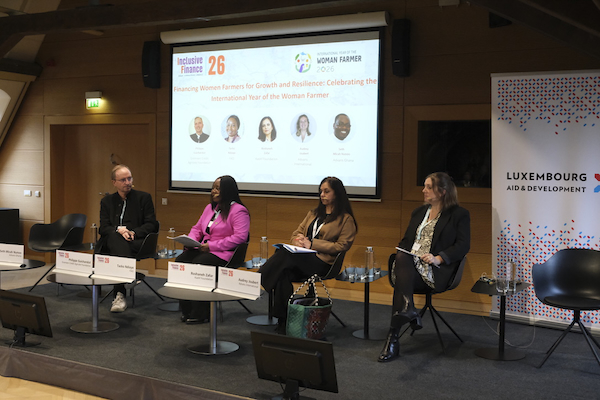
 (L-R) Philippe Guichandut, Grameen Crédit Agricole Foundation; Tacko Ndiaye, FAO; Roshaneh Zafar, Kashf Foundation; Audrey Joubert, Advans International;
Credit: Steven Miller, Chronicle.lu
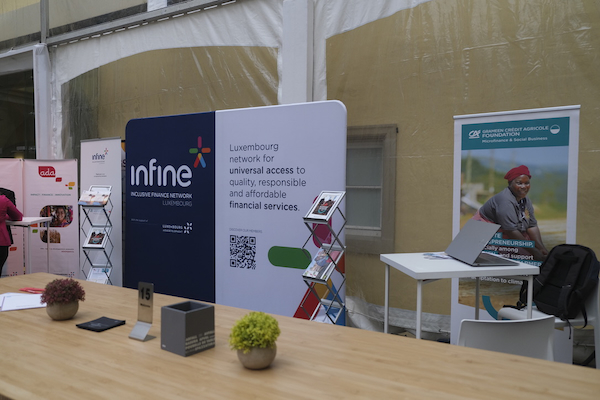
On Wednesday 11 November 2026, the first day of the Inclusive Finance 2026 conference opened at Neumünster (neimënster) in Luxembourg-Grund with sessions introducing the premise of inclusive finance, finance ecosystem mapping, a guided AI experience by the Luxembourg House of Fintech (LHoFT) and discussions on subjects such as financial inclusion, microfinance and climate resilience.
The three-day conference, organised by the European Microfinance Platform (e-MFP), is regarded as one of the top events in the financial inclusion calendar, offering a unique meeting point for microfinance and financial inclusion professionals worldwide. The event brings together professionals and organisations from around the world who are committed to promoting more inclusive access to financial services, gathering a wide range of stakeholders, including consultants, support service providers, investors, national and multilateral development agencies, NGOs and researchers.
For the 2026 edition, the organisers have expanded the audience and welcomed members of the financial and fintech ecosystem while extending an invite to those curious about inclusive finance, or those already involved in the various sectors it represents. The programme includes more than 25 thematic and plenary sessions addressing the sector’s key current challenges, along with a variety of workshops, action groups and side events.
Chronicle.lu attended the afternoon session “Financing Women Farmers for Growth and Resilience: Celebrating the International Year of the Woman Farmer”, which explored solutions for women farmers and entrepreneurs facing barriers to growth.
The panel discussion, moderated by Philippe Guichandut of the Grameen Crédit Agricole Foundation, featured contributions from Tacko Ndiaye, Gender Team Leader at FAO; Roshaneh Zafar, Kashf Foundation; and Audrey Joubert, Advans International, with Seth Micah Nunoo, Chief Business Development Officer at Advans Ghana joining online.
The discussion touched on subjects such as gender bias, gender inequality relating to access to financing, education and land ownership rights, microfinancing, the impacts of climate change and the need for produce diversification, food security and mobility issues.
On the subject of female representation in agriculture, Tacko Ndiaye said: “Across the world, women are the backbone of agri-food systems. They grow crops, raise livestock, catch fish, manage forests, process food, trade in markets, teach and innovate. Their work leads through the land, the water and the knowledge that sustain us, connecting food from the farm to our tables. Women make up 41% of the global agri-food workforce, yet too often they have less access to land, finance, technology and training. When women farmers are empowered, everyone benefits. Hunger diminishes, dietary diversity increases, incomes grow, and households are more resilient to shocks. Closing gaps between women and men in agri-food systems can be transformative. It could reduce food insecurity by 45 million people.”
In relation to the specific issues faced by women farmers, Roshaneh Zafar noted: “Women are really not in the monetised farming system. So what happens is they are providing on smallholder farming, or even as producers of dairy, they are the ones doing all the hard work, they are doing the heavy lifting, but they are not on the monetary or the marketing side of it. And that is one area which holds them back, because they do not have the voice, they do not have the agency, and they do not have the connection to how the business is growing, or how the systems are going forward. That limits the access to opportunities, whether we are talking about credit, whether we are talking about inputs, whether we are talking about access to the correct seed, or technology, or extension work, or trainings. All of that holds them back.”
On how these issues impact women farmers in Ghana, Seth Micah Nunoo stated: “More or less see the same issues in Ghana. If you look at our food costs, women play a very critical role. 90% of the food we eat, in terms of transportation from the farm gate to our dining table, is done by women, and women are involved in 70% of the production of food cost. However, when you look at the land demand with them in Ghana, women own 80% of our whole land, compared to men, that the family own by 30… In Ghana men are twice as likely to get an access to a formal loan, compared to women.”
Tacko Ndiaye and Roshaneh Zafar both noted the impact of digital literacy, particularly in regard to how applications for funding and payments are handled digitally, with women encountering problems because of a lack of education in this field.
Audrey Joubert detailed the steps being taken in relation to removing the existing barriers to financial inclusion, describing the work of local and international NGOs in Ghana, Côte d'Ivoire and the Democratic Republic of Congo, and the progressive design of a full range of products and services which give women access to, at first, savings accounts, and later, lending mechanisms.
When asked to summarise the main challenges women face in farming in Africa, the panel agreed that climate change was a considerable factor, impacting existing crops and prompting the need for crop diversification in the future, as these environments suffer the impacts of a changing climate.
Audrey Joubert said: “There is a challenge to support diversification and a specific challenge also for these women in the rural area. We need to find innovative ways to finance and support this diversification.”
“I believe that technology can democratise a lot for us, especially in terms of access, but we have to have the right guardrails to protect the client and the industry”, added Roshaneh Zafar.
In closing, Tacko Ndiaye emphasised the significance of the United Nations declaring 2026 the International Year of the Woman Farmer, stating: “I want to say is that the year was never meant to be a finish line. The year was meant to be a launchpad.”
She added: “[We need] greater strategies in terms of involving women in the design, for the design for women, with women products that work for them. Because when you talk to women farmers, they have a clear idea of what they want… They want little or no collateral, they want loans in kind, delivery through their solidarity groups, and being able to provide payments, loans for pre- and post-harvest work, and small loans for equipment that they can operate themselves. Those are some of the concrete things that they ask for. We also need to secure land and property rights for women, including the registration of equipment, the livestock and mobile phones in their own names. We also need financial and digital literacy for women.”
There then followed a brief Q&A session involving members of the audience.