 Credit: Saily
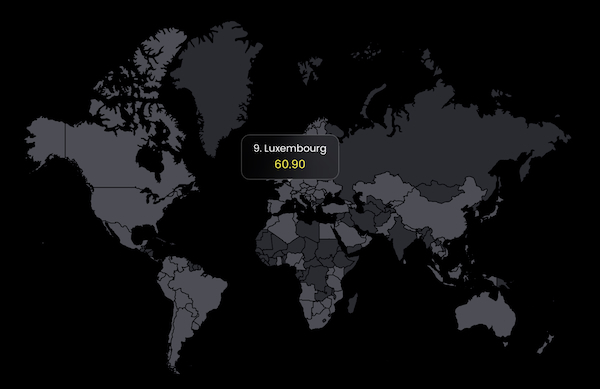
On Tuesday 7 July 2026, travel eSIM application Saily reported that Luxembourg ranks ninth globally in an international study on the best countries for internet connectivity.
Saily noted that Luxembourg has risen seventeen places this year, moving from 26th to ninth place, placing it among the world’s top ten. Estonia tops the ranking, followed by Lithuania, Denmark, Portugal and France. Saily remarked that this progress reflects broad and consistent improvements and positions Luxembourg among Europe’s best-performing countries in digital connectivity.
For the study, 97 countries were assessed based on cybersecurity, internet quality, affordability and freedom. These criteria combine various detailed attributes and are used to evaluate internet performance.
Saily attributed Luxembourg’s placing to its performance: the Grand Duchy ranks ninth worldwide for internet quality, with internet access freedom firmly positioned in 23rd place and cybersecurity in 39th place. Conversely, the study showed Luxembourg’s weakest area as affordability, where it ranks 49th. However, the combination of fast, reliable connections and a balanced overall profile placed Luxembourg into top ten.
“Luxembourg’s entry into the global top ten this year has been made possible by fast and high-quality connections. For travellers and remote workers, this reliability is exactly what they are looking for as soon as they land,” explained Vykintas Maknickas, CEO of Saily.
According to Saily, Europe dominates the global ranking. Of the fifteen best-connected countries in the world, thirteen are European, and the top three (Estonia, Lithuania and Denmark) represent what a high-performing and comprehensive digital environment looks like.
Beyond the podium, the remainder of the top fifteen resembles a map of Western and Northern Europe: France, the Netherlands, Austria, Luxembourg, Finland, Germany and the United Kingdom.
Moldova is the most surprising new entry into the global top 15. The country gained more places in a single year than any other country in the sample, moving from outside the top 60 to eighth place worldwide. This progress is attributed to a dramatic expansion of internet freedom.
Chile completes the top fifteen as the only representative of Latin America at this level, achieving performance levels close to European standards. It stands out clearly from the rest of the continent and offers a model that other Latin American countries could aspire to.
Vykintas Maknickas noted: “When something unexpected happens abroad, for example if you miss a flight or need medical care, the first thing you turn to is your phone. Checking that your mobile connection will actually work is one of the most important things to prepare before packing your bags.”
The CEO of Saily added that for travellers, practical advice for a smooth journey and a secure internet connection includes:
• being cautious with public Wi-Fi networks. Connect to the Wi-Fi at your hotel or airport, complete the registration page, then activate your VPN if you have one. If a Wi-Fi login page asks you to install anything, refuse.
• Using your mobile data for sensitive tasks. If you need to access your bank account, it is better to use your mobile data: this reduces the risk of someone monitoring your online activity.
• consider using an eSIM. An eSIM data plan is often cheaper than roaming. Buy one from official operators or reputable applications and beware of scammers selling fake services.
• prepare your offline kit. If you are travelling to a destination known for poor connectivity, download maps and playlists over Wi-Fi, activate “Data Saver” or “Low Data Usage” mode, and pause photo and video cloud backups when using mobile data.
• know which services are blocked. Check before departure and make sure you have the applications you need before you leave.
Full results of the study can be viewed at https://saily.com/internet-connectivity-index/#our-findings