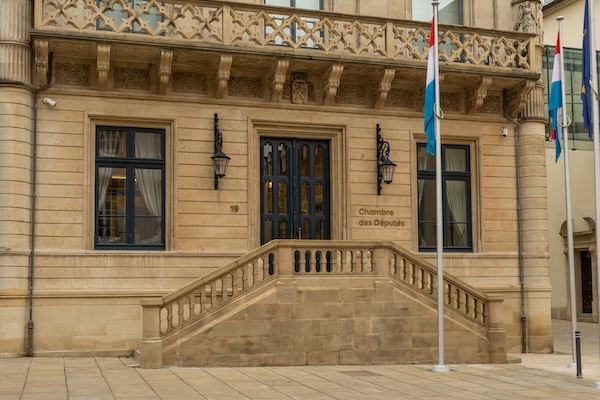
 Credit: Ali Sahib, Chronicle,lu
On Tuesday 7 July 2026, Luxembourg's Ministry of State and the Media, Connectivity and Digital Policy Department reported that the Chamber of Deputies (parliament) had adopted Bill No. 8421 on the promotion of professional journalism and democratic debate.
According to the ministry, the new law strengthens access to information, adapts the system of financial support for professional journalism and updates the definition of a professional journalist.
Luxembourg’s Prime Minister Luc Frieden said: "A strong democracy relies on free, pluralistic and accessible information. The new law improves the conditions under which journalists can carry out their mission in the public interest, notably through a right of access to information long advocated by the Press Council. This is a major step forward that confirms the government's commitment to strengthening our democracy."
The ministry noted that the legislation modernises the framework established by the amended law of 14 September 2018 on transparent and open administration, in line with the requirements of the Council of Europe Convention on Access to Official Documents (the Tromsø Convention).
It explicitly recognises the essential role of professional journalists in a democratic society by granting them the right to access information held by public bodies as part of their mission of informing the public.
Among the main changes introduced by the law are a broader definition of the term "document", covering any recorded information regardless of format, an obligation for public bodies to assist applicants in identifying the documents they seek, the introduction of an acknowledgement of receipt indicating the estimated processing time for requests, clearer procedures for refusals and appeals, an expanded list of bodies subject to transparency obligations and the possibility of releasing partially redacted documents where certain information is protected by law.
The ministry added that these changes strengthen legal certainty while facilitating effective access to public information.
The ministry also reported that the law introduces targeted adjustments to the financial support scheme established in 2021, taking into account experience gained since its implementation and developments in the media sector.
The adopted measures include:
- the introduction of de minimis aid to support innovative or smaller-scale journalism projects;
- the removal of different aid ceilings depending on the type of publication, in line with the principle of technological neutrality;
- the indexation of all aid amounts;
- more flexible eligibility conditions for media start-ups.
According to the ministry, these measures aim to preserve the long-term pluralism of Luxembourg's media landscape and encourage the emergence of a wider range of journalistic initiatives, including smaller projects.
The ministry added that the law also updates the definition of a professional journalist.. It confirms that journalism must be the applicant's main profession, exercised for at least three months before applying for a press card, and that professional journalism is incompatible with any activity related to advertising.
Luxembourg’s Minister Delegate to the Prime Minister for Media and Connectivity Elisabeth Margue said: "This reform responds to the profound changes in the media landscape. It provides greater legal clarity, strengthens the tools supporting professional journalism and promotes more effective access to public information, in accordance with democratic principles and the rule of law.” She added: "The completion of this legislation reflects extensive consultation with all relevant stakeholders. We listened to the sector and acted in line with the principles of an agile media policy based on an analysis of realities on the ground in order to ensure a pluralistic, innovative and resilient media landscape."