 Anne Calteux, European Commission representative;
Credit: Elza Osmane, Chronicle.lu
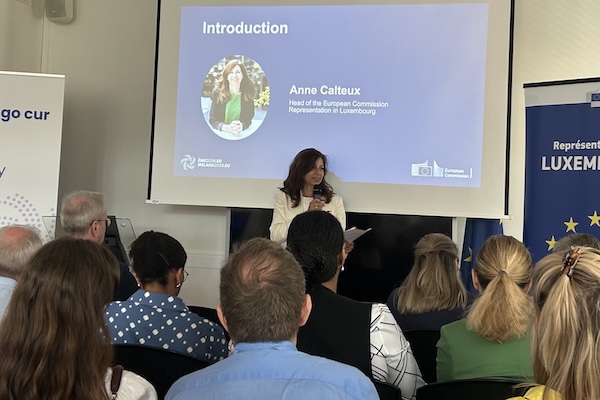
Anne Calteux, European Commission representative;
Credit: Elza Osmane, Chronicle.lu
On Wednesday 1 July 2026, the first day of Ireland's Presidency of the Council of the European Union (EU), the European Commission Representation in Luxembourg and the Embassy of Ireland organised a presentation of the presidency's priorities at the Foyer Européen in Luxembourg-Gare.
The event, held in English, gathered around 70 attendees, including diplomats and representatives of EU institutions. It showcased the priorities that will guide Ireland's presidency until 31 December 2026, when it will hand over the role to Lithuania.
Anne Calteux, Head of the European Commission Representation in Luxembourg, opened the event by explaining the role of the rotating presidency.
She said the presidency’s role is to chair Council meetings, seek compromise among member states and help advance the EU’s legislative agenda while acting in the general interest of the Union. She also highlighted achievements of the Cypriot Presidency, including progress on enlargement, the EU’s long-term budget, support for Ukraine, defence cooperation, migration and an agreement on EU air passenger rights after thirteen years of negotiations.
Ireland's Ambassador to Luxembourg Jean McDonald then presented Ireland’s presidency programme, introduced by an official video. She noted that this marks the eighth time Ireland has held the presidency and said the country assumes the role at “a critical time for Europe”, amid geopolitical tensions, ongoing conflicts and rising costs for households and businesses.
She moved on by introducing Ireland's presidency with the old Irish proverb "Ní neart go cur le chéile" (strength with unity), which will guide the country's six-month term. Ambassador McDonald then outlined the presidency's three main pillars: competitiveness; security; and values. She added that this is the first Irish presidency during which Irish is a fully operational official language of the EU.
The presentation also highlighted the importance of the next Multiannual Financial Framework (MFF), outlining the presidency's objective of advancing discussions on the EU's long-term budget.
It also reflected on Ireland's experience of EU membership, highlighting the country's economic development alongside certain social changes. Among the examples mentioned was the abolition of the Marriage Bar, which until 1973 had required many women to leave their jobs upon marriage.
The event continued with a multilingual Q&A session, during which participants raised questions on enlargement, EU-Mercosur trade, defence, security and the EU budget. On enlargement, Ambassador McDonald reaffirmed Ireland’s support for candidate countries and said the presidency would seek to help maintain momentum in the accession process.
Looking ahead, Ambassador McDonald highlighted several initiatives planned during Ireland's presidency. Under the County Pairing Initiative, each of Ireland's 26 counties has been paired with an EU member state. County Carlow has been paired with Luxembourg, reflecting its longstanding historical links with Echternach through Saint Willibrord.
The event concluded with a networking reception.
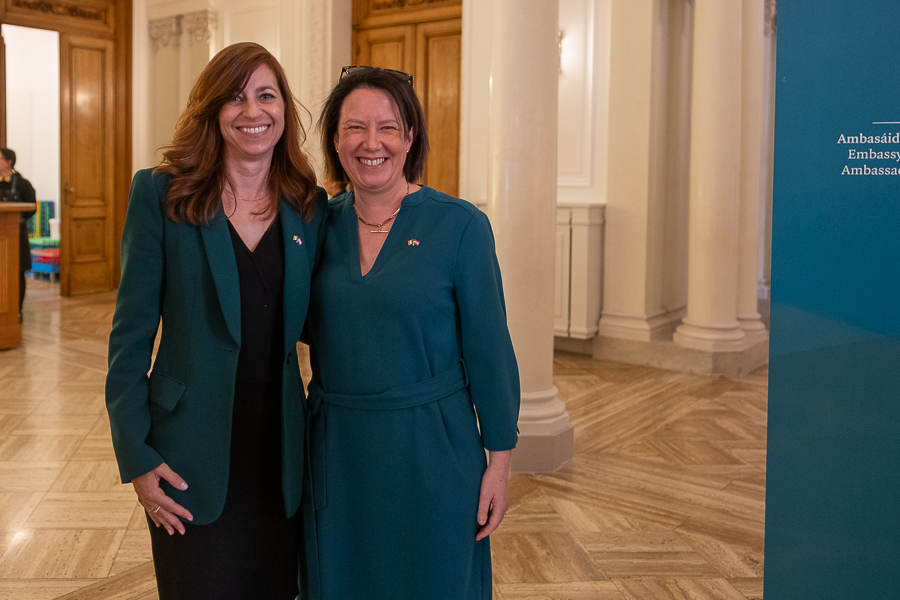
Photo Caption: (L-R) Anne Calteux, European Commission representative; Irish Ambassador, Jean McDonald celebrating St Patrick's Day on 17 March 2025;
Photo Credit: Ali Sahib, Chronicle.lu
SC/EO