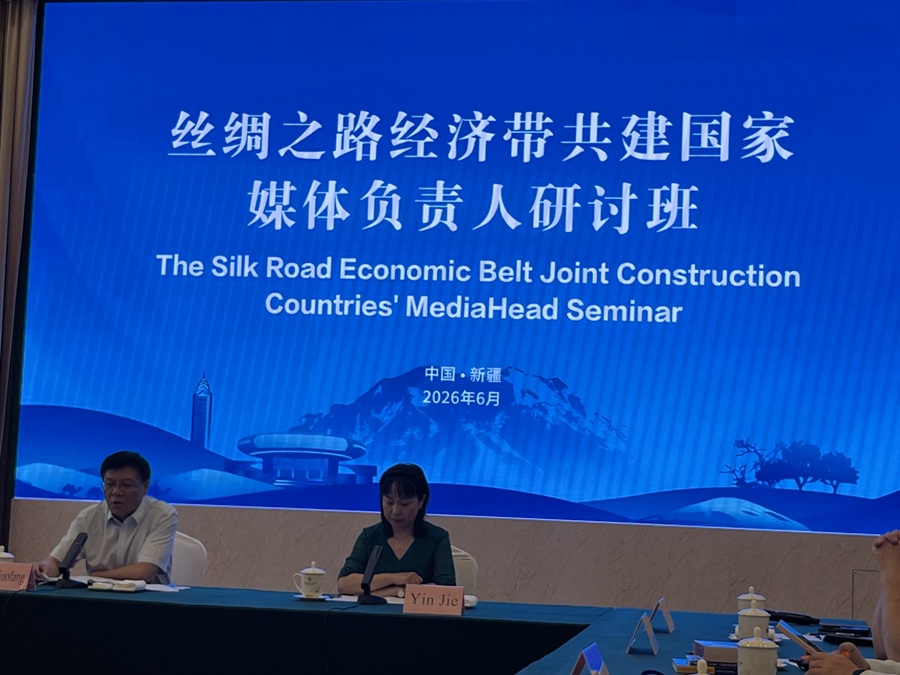
 Urumqi visit Opening Ceremony;
Credit: Chronicle.lu
Urumqi visit Opening Ceremony;
Credit: Chronicle.lu
In connection with the Belt and Road Initiative (BRI), I was recently invited to visit Ürümqi, the capital of Xinjiang in China's north-west, close to Kazakhstan in the west and Kyrgyzstan to the south-west, with Russia to the north and Mongolia to the north-east.
The BRI draws on the ancient Silk Road, a vast, ancient network of Eurasian trade routes active from around 130 BC until the mid-15th century AD. The BRI focuses on connectivity and cooperation among countries, and aims to enhance policy coordination, facilitate connectivity, unimpeded trade, financial integration and people-to-people bonds, and also build a new platform for international cooperation to create new drivers of shared development.
I was part of a large international group of around 20 editors-in-chief and senior journalists from sixteen countries across Asia, Europe and beyond. A separate group, of primarily visual media representative - photographers and camera operators, plus some journalists - were in a second group with a shorter itinerary, but our paths did not cross.
With different titles "Visiting the Core Zone of the Silk Road Economic Belt Themed Interview", "Silk Road Economic Belt Joint Construction Countries' Media Head Seminar" and "Seminar for Media Executives from Countries Jointly Building the Silk Road Economic Belt" being used to describe the event - possibly arriving from different translations from the original Chinese - it was slightly confusing before arrival, but once I received the confirmed itinerary, everything fell into place as the itinerary was cemented and clarified.
The conference and visit comprised daily lectures (at the end of which we could ask questions) and site visits to economic, historical, cultural and religious sites, with simultaneous interpretation services provided in English, Spanish, Japanese and Russian.
Opening Ceremony
At the Opening Ceremony, the speaker opened by describing Urumqi as the Pearl of the Silk Road, welcoming the participants and thanking the organisers, the Information Office of the State Council and the China International Communications Group.
He talked about the Silk Road transcending mountains and rivers to “bind us closely together”, and “traverses history to inject inexhaustible momentum into our shared prosperity and development”. He recalled camel trains carrying silk, porcelain and tea westward to Europe, and bringing wheat, grapes and carrots eastward to China.
He explained how “Eastern and Western civilisations intertwined and converged along the Silk Road, colliding with and influencing each other to create a radiant brilliance”. Turning to the present, he stated that “the Belt and Road Initiative has reawakened our Silk Road memories of commercial exchanges and mutual learning”.
He advocated the current construction of the core area of the Silk Road Economic Belt, deepening economic and trade exchanges with countries around the world, and injecting new vitality and bringing new opportunities.
Talking about Xinjiang, he stated that it is the largest province in China by area and that it comprises “vast deserts, boundless Gobi plains, lush oases, expansive grasslands, towering snow-capped mountains, and azure lakes” — "all of which are deeply captivating”.
With an enduring cultural heritage, Xinjiang is a place where four major world civilizations converge, and multiple cultures blend and coexist. Along the ancient Silk Road, cultural landmarks such as the Ancient City of Loulan, the Ruins of Jiaohe, the Kizil Thousand Buddha Caves, and the Id Kah Mosque can be found. And “across the vast land of Xinjiang, folk activities including the Lantern Festival celebrations, the Twelve Muqam, Meshrep, Aitys, Komuz singing gatherings, and Naadam fairs” are part of the region’s rich cultural heritage which embrace different ethnic cultures in Xinjiang.
One of the event’s biggest takeaway was that “Since ancient times, Xinjiang has been a home to multiple ethnic groups, multiple religions, and diverse cultural exchanges. Today, Xinjiang is the common homeland of all 56 ethnic groups in China”, living together in harmony.
He also mentioned that, in the past, Xinjiang experienced frequent violent terrorist attacks and conducted law-based counter-terrorism and de-radicalisation efforts, advancing the rule of law and maintaining stability, peace and security.
Ürümqi's history
Ürümqi is the capital of Xinjiang; it has population of 4 million (2020), the 2nd-largest city in China's north-western interior after Xi'an (Xinjiang has a population of over 26 mission). Ürümqi has seen significant economic development over the past 30 years and currently serves as a regional transport hub and a cultural, political and commercial centre.
In ancient times, Xinjiang was known as "Western Regions" (Xiyu), meaning the western frontier of China. In 60 BC, the Western Han Dynasty establised the protectorate of the Western Regions in Wulei in present-day Luntai County, marking the formal administrationof the Xinjiang region into Chinese territory.
Ürümqi was taken by the Qing in 1755; a few years later, the Qing government established state farms in the under-populated areas around Ürümqi, where there was fertile, well-watered land. In 1884, the Qing government established Xinjiang as a province; in September 1949, Xinjiang was peacefully liberated. On 1 October 1955, the Xinjiang Uygur Autonomous Region was established, with its capital in Urumqi. On 1 February 1954, following the founding of the People's Republic of China, the city's name of Dihua was officially changed back to Ürümqi, and became the de facto political and economic capital of Xinjiang in 1962.
Originally known as Luntai, the city was founded in 648 AD and collected taxes from the caravans along the northern route of the Silk Road. The region later came under the control of the Uyghurs, but there were no permanent settlements there for most of this period.
Importantly, the Ürümqi of the early period was a twin-city, with Gongning Cheng forming the administrative centre while Dihua grew into Xinjiang's commercial and financial centre.
Chinese Hui Muslims move from the areas of Gansu and Shaanxi; by 1762, more than 500 shops had already been opened by Chinese migrants to the area of modern-day Ürümqi.
The Chinese government began construction on a railway connecting Ürümqi to China proper in the east. As a result, Xinjiang was culturally and economically reoriented away from Central Asia and toward China proper. In the late 1970s, Deng Xiaoping relaxed China's tight control over Xinjiang, and Ürümqi benefited from the development of the oil and gas industry in Xinjiang. New mosques were built in Ürümqi with financial assistance from the Chinese government.
Currently 56 ethnic groups live in Ürümqi; around 75% of the population is Han Chinese, with around 13% being Uyghur, with others including Kazakhs, Mongols, Russians, Uzbeks, etc., with religions practiced including Islam, Buddhism, Taoism, Christianity and Eastern Orthodox Christianity.
Ürümqi's geography
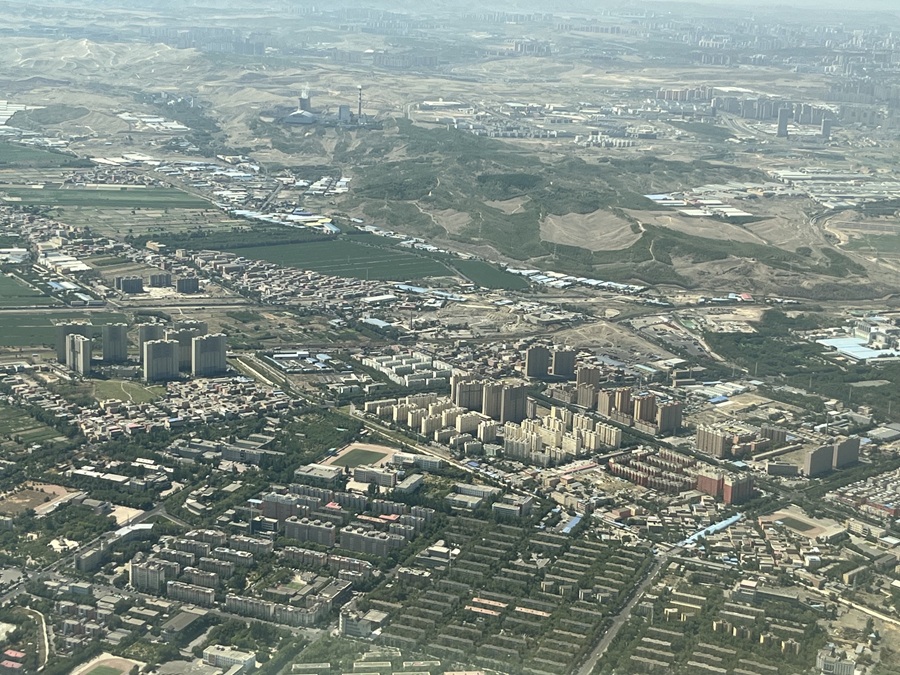
Located in the north-west of China, Ürümqi is close to Kazakhstan and Kyrgyzstan to the west, as well as Mongolia to the north.
Ürümqi is located in two river basins flowing though deserts, surrounded by three mountain ranges: the Altai in the north, the Kunlun in the south, and the Tianshan running across the middle.
There are 20,000 glaciers in Xinjiang – nearly half of all the glaciers in China.
Ürümqi's economy
Xinjiang's economy has been accelerated by the operation of the Guangdong-Xinjiang Express and the Tianshan cargo trains, and international cargo air routes directly connecting the Baltic Sea and South Africa have been opened, with customs clearance procedures being improved significantly.
In the petro-chemical sector, Ürümqi has significant oil fields and natural gas reserves, as well as traditionally being a core source of coal and, more recently, green energy.
It has a good agricultural economy too, from grapes to water melons grown in the fields, to animal husbandry for sheep and cattle.
In manufacturing, Ürümqi has a solid industrial heritage in textile production, partly from its cotton production.
And it has a growing tourism industry which includes a number of historical sites which showcase the region's influence by different visitors bringing religion, culture, history and tradition, all of which are currently embraced as representing what makes up Xinjiang and its heritage.
Getting there and staying there
Although China Southern Airlines flies direct to Henan, and this route is served just once a week, I flew Turkish Airlines to Istanbul (a three-hour flight) and then just a couple of hours wait until I took a China Southern Airlines flight direct to Urumqi (five and a half hours).
In Urumqi, we stayed at the Kunlun hotel which, while comfortable and cheerful, only had wifi in guest bedrooms, i.e. not on the lobby or conference rooms. Meals were all buffet style, which was absolutely fine, and some of the dishes were delicious, having the same style food three times a day started to wear thin after a few days. It was similar to when I was India a while ago: I absolutely love the cuisine, but after a few days of all meals virtually the same…
Driving around
The road network in and around Urumqi is extensive, but some road surfaces need resurfacing, not helped by the suspension of the buses we were using; there is lots of greenery, but not necessarily characterised by specific flowers; again, I am comparing to my recent visits to Zhengzhou and Luoyang in Henan.
The makes of car on the roads seemed to be a mix of European, American and Asian, with Chinese brands becoming more popular, including electric vehicles, but possibly not as advanced as in other Chinese cities I recently visited. This is partly down to the charging infrastructure here not being as advance as in other cities / regions, and the main reason for this is the presence her of the deserts.
I also learned that hybrid cars are registered with an "F" in their number plate, and electric vehicles had a "D" in theirs; both had green registration plates, compared to blue for traditional combustion engine vehicles.
In Urumqi, I could observe many construction projects starting or nearing completion, illustrating economic prosperity.
Days 1-6
Please see below for links to what we got up to on each of the six days:
- Day 1, Urumqi: Urumqi International Land Port; CRCC Heavy Industry Xinjiang Co Ltd; Xinjiang Islamic Institute; Lecture on China's Religious Policies
- Day 2, Urumqi: Themed Exhibition marking the 70th anniversary of the founding Xinjiang Uygur Autonomous Region; Xinjiang Software Park; Xinjiang Museum; Lecture on Historical issues concerning Xinjiang
- Day 3, Korla: Trip from Urumqi to Korla, Yanqi County; Tianshan Victory Tunnel; Bosten Lake in Yanqi County; Korla
- Day 4, Korla: Bayingolin People's Hospital; Yungengji Smart Farm Demonstration Base; No 23 Middle School of Korla City; Tuanjie Community in Korla City; Lecture on Economic Development and Livelihood Improvement
- Day 5, Turpan: Train for Korla to Turpan; Turpan City; Ruihong Textile Co Ltd; Longyuan Turpan New Energy Co Ltd; Lecture on Information Manipulation; Jiaohe Ruins
- Day 6, Turpan: Bezeklik Thousand Buddha Caves; CCCC Flaming Mountain Vehicle Inspection Co Ltd; Karez Underground Canal; Train to Urumqi; Xinjiang International Grand Bazar
Conclusions
This visit to the north-western Xinjiang province was a real eye-opener and was very different from previous visits to other Chinese provinces.
Whilst the cities were comparable in many ways, the main differences here were geographical, with mountainous and desert topography showing that early visitors from the west had a really tough journey to complete to be able to continue along the old Silk Road. Back then, even the Great Wall of China did not extend this far and, instead, Beacon Towers were used to emit smoke during the days and fire at hight, to send signals. More recently, roads and railways emerged to aid trade along the Silk Road which was also a route for migration.
Here in Luxembourg we refer to society being very multi-cultural, with approximately 50% of residents being non-national and another 20% or so arriving daily as cross-border workers. It is not dissimilar (the double negative here is intentional) in Xinjiang, but there they refer to the multi-ethnicity of the population, with different cities/towns including different languages in addition to Mandarin Chinese on street signs, etc.
In addition to being shown around a vast number of different economic / business as well as cultural and historic sites (Museums, ruins, etc.), we were also presented with almost daily lectures which mostly focussed on presenting China's perspective on issues such as some reports in the western media, etc., with which they disagreed: these topics included China's attitude to / treatment of the the local Uyghur population and the use of what China refers to as "Vocational Training Centres" or "De-radicalisation camps", described by some in the west as "brainwashing" or "concentration camps".
Trying to understand all perspectives, my take on this is that travel opens up one's mind to different ways of life, etc., and when travelling to different countries we need to respect the laws of each - if we don't like them, we don't have to go there. Many years ago, when our family visited Singapore for the first time, I mentioned to our children not to chew chewing gum as it was forbidden there. Just like in some countries whose courts follow the strict interpretations of Islamic (Sharia) law, someone found guilty of stealing can have fingers or hands amputated. In the west, most punishments are imprisonment and/or fines, but in China they also have "re-education" in certain circumstances.
Another big thing for me was the desert and how the local communities have adapted to the elements, both historically by the creation of the Karez underground canals, and more recently by developing modern technological irrigation systems. While we were shown such technologies in operation, for me the big thing was being able to reclaim parts of the desert for agriculture - this could have massive implications as global temperatures rise...
The extreme heat (it reached 50.5C on the last full day) on the edge of the Gobi desert was certainly an experience, but at least the humidity was low. I really enjoyed an evening stroll yesterday evening back in Europe in just 18C, and wearing a jumper...
And visiting some modern museums as well as ruined towns from centuries ago gave me an understanding of how the Silk Road used to operate, how it brought in other cultures, languages, customs, traditions and religions, and how the Belt and Road Initiative had built on the early days and now continues to serve as a thoroughfare for exchanges of ideas, trade, culture and cooperation.
The links above are to the daily chronicles of the trip, reporting on everything we were shown and saw. Like any such press trip, we had a relatively fixed itinerary and we saw what we were shown. We also had interpreters with us continually and we could ask them, as well as representatives of thee organisers, anything we wanted related, or not related, to the itinerary, and we would always get answers.
UPDATED to add the conclusions.