 Pascal Jossi;
Credit: Bahá’í Community of Luxembourg
On Monday 9 November 2026, the Bahá’í Community of Luxembourg announced that it held the sixth edition of its annual workshop series “Exploring Community-Building in Luxembourg”, which brought together representatives from civil society, public institutions and research to discuss ways to strengthen social cohesion and a shared sense of belonging.
Organised in collaboration with the UNESCO Chair in Human Rights at the University of Luxembourg (Uni.lu), the event was held in Uni.lu premises on Friday 6 November 2026.
It explored how people from different cultural backgrounds can move beyond coexistence towards actively shaping their communities together.
The workshop took place within the framework of the “Biergerpakt” as Luxembourg prepares its next national action plan on intercultural living-together. Participants included representatives from Luxembourg’s Ministry of Family Affairs, Higher Council for Intercultural Living Together, STATEC and ASTI, among others.
According to the Bahá’í Community, for the first time in the workshop series, research findings were incorporated into the discussions to strengthen exchanges between researchers, policymakers and community representatives.
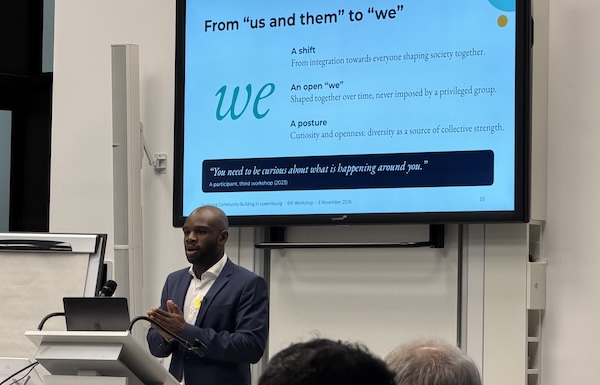
Talia Melic from the Organisation for Economic Co-operation and Development (OECD) presented research on neighbourhood-based initiatives, while Kelsey O'Connor from STATEC Research shared findings on well-being and happiness; Anna Topliyski from Citizens for Ecological Learning and Living contributed insights from community initiatives focused on environmental and social justice; professor Robert Harmsen, Dean of the Faculty of Humanities, Education and Social Sciences at the Uni.lu, moderated the roundtable following an opening keynote by Pascal Jossi from the Bahá’í Office of Public Affairs of Luxembourg.
The discussions examined how research and practical experiences can inform public policies and help create environments that encourage participation and a shared sense of belonging.
During an afternoon workshop, participants explored ways to strengthen communities through trust, meaningful relationships, continuous learning and opportunities for people from different backgrounds to work towards common goals.
They also identified barriers to participation, including language differences, time constraints and limited access to suitable spaces.
According to the organisers, discussions highlighted that a sense of community develops not only through institutional support but also through shared experiences and collective efforts. Participants examined how regular reflection and the exchange of experiences could improve community initiatives, while public institutions could support grassroots activities without limiting their independence.