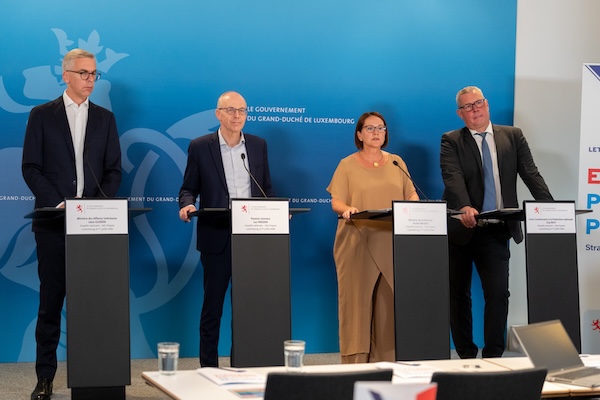
 (L-R) Léon Gloden, Luxembourg's Minister for Home Affairs; Luс Frieden, Luxembourg's Prime Minister; Yuriko Backes, Luxembourg's Minister of Defence; Guy Bley, High Commissioner for National Protection;
Credit: SIP / Emmanuel Claude
(L-R) Léon Gloden, Luxembourg's Minister for Home Affairs; Luс Frieden, Luxembourg's Prime Minister; Yuriko Backes, Luxembourg's Minister of Defence; Guy Bley, High Commissioner for National Protection;
Credit: SIP / Emmanuel Claude
On Wednesday 1 July 2026, Luxembourg's Prime Minister, Luc Frieden, Minister of Defence Yuriko Backes and Minister for Home Affairs Léon Gloden presented the results of the country's first national survey on the perception of risks and threats, conducted as part of the National Resilience Strategy (SNR).
Conducted among a representative sample of 1,500 residents, the survey examined public perceptions of risks and threats, levels of awareness and individual preparedness for potential crises.
According to the Ministry of State, Ministry for Home Affairs, Directorate of Defence and High Commission for National Protection, the findings indicate that the population is generally well-informed and aware of the main risks, particularly cyber threats and economic risks. However, a significant gap remains between awareness and the ability to respond effectively.
While 85% of respondents said they regularly seek information, almost one in two admitted they do not know exactly how to act in the event of a crisis.
The survey also found that:
- the most tangible risks are perceived as the most likely;
- major but less tangible risks, such as nuclear incidents or military conflicts, are viewed as less likely but potentially having severe or catastrophic consequences;
- basic preparedness, including smoke detectors (71%) and emergency supplies, is relatively widespread but remains insufficient for dealing with major crises.
The survey also revealed significant potential for civic engagement. A large majority (86%) said they would be willing to help neighbours or volunteer as part of a civil protection, healthcare or military reserve (60%).
Trust in public institutions remains generally high, particularly regarding the continuity of essential services (83%). However, respondents also expressed expectations for clearer, faster and more practical information during crises.
In light of the findings, the government intends to focus on several priorities:
- improving access to clear, practical and multilingual information;
- developing practical preparedness tools, including guides, emergency kits and training;
- increasing the visibility of existing systems, such as LU-Alert and public information platforms;
- placing particular emphasis on young people and vulnerable groups, who were found to be less prepared;
- encouraging civic engagement and local solidarity.
According to the authorities, these measures form part of a whole-of-society approach involving public institutions, municipalities, businesses and citizens.
During the press conference, the three members of government outlined the implications of the findings within their respective areas of responsibility.
Prime Minister Frieden emphasised the importance of strengthening Luxembourg's resilience to all types of crises, ensuring the continuity and coordination of essential services and maintaining public confidence in government action.
Minister Gloden stressed that resilience is a shared responsibility involving the State, municipalities and citizens. He highlighted the publication of a thirteen-step guide to help municipalities develop Local Resilience Plans (PLRs), the role of CGDIS as Luxembourg's civil protection service, the continued development of the LU-Alert national warning and information system, and the establishment of RESC-LU within CGDIS as a national reserve of specialised capabilities to support local and national authorities during disasters.
Minister Backes addressed the challenges posed by evolving security and military threats in the international environment, as well as the importance of civil-military cooperation and coordination.
The authorities stressed that resilience is a shared responsibility involving society as a whole and depends on every citizen being informed, prepared and able to respond appropriately in the event of a crisis.
As Prime Minister Luc Frieden said: "Being informed is not enough — we must know how to act. Resilience is built together. It depends on each and every one of us."
The next steps will include awareness-raising campaigns, the distribution of practical tools, including the "Lëtz prepare!" guide, and further initiatives to encourage civic engagement.
The "Lëtz prepare!" guide helps residents prepare for emergencies by providing practical advice on building emergency supplies and assembling a 72-hour emergency kit. It also explains how the LU-Alert national warning and public information system operates and outlines the actions to take during emergencies.
The authorities described the survey as an important foundation for shaping public policies on crisis prevention and management. It will be used to adapt awareness-raising measures and improve Luxembourg's preparedness for future challenges. They reaffirmed their commitment to strengthening the country's collective resilience to risks and threats through a shared sense of responsibility.