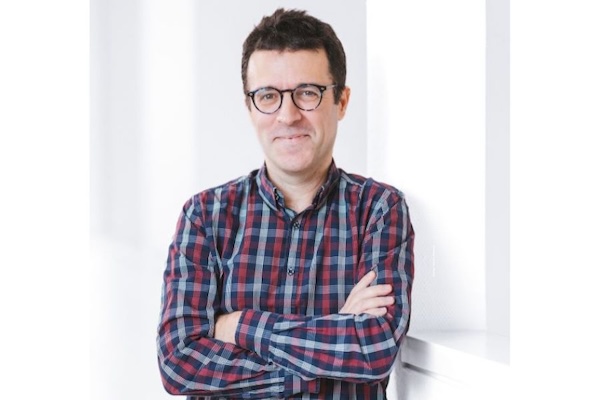
 Jorge Íñiguez-González, Head of the Modelling of Functional Materials group at LIST;
Credit: LIST
Jorge Íñiguez-González, Head of the Modelling of Functional Materials group at LIST;
Credit: LIST
On Thursday 25 June 2026, the Luxembourg Institute of Science and Technology (LIST) announced that Head of the Modelling of Functional Materials group at LIST Jorge Íñiguez-González has been awarded a European Research Council (ERC) Advanced Grant worth close to €2.5 million for a project exploring a new generation of programmable materials.
The five-year project is expected to begin in early 2027. According to LIST, ERC Advanced Grants are among Europe's most prestigious research awards and support established scientists pursuing ambitious, high-risk, high-gain research.
The research builds on work published in Nature in 2024, in which Jorge Íñiguez-González and colleagues developed a new approach to designing materials by stacking ultra-thin crystalline oxide layers at carefully controlled angles. The approach forms part of the emerging field of "twistronics", where changing the angle between layers can significantly alter a material's behaviour.
"Today, these materials are generally created with a fixed twist angle that remains unchanged," explained Jorge Íñiguez-González. "Our ambition is to investigate whether we can actively control that angle and reconfigure the material whenever we want, using very little energy. If successful, it would allow us to dynamically programme a material's properties instead of being locked into a single configuration," he added.
Changing the twist angle could alter a wide range of material properties, including electrical, optical and magnetic responses. Such adaptability could eventually open new possibilities for information storage, sensing technologies and next-generation computing architectures that consume far less energy than today's systems, said the LIST.
The project will focus on ferroelectric oxides, a family of highly responsive materials that react strongly to external stimuli such as electric fields, temperature changes or mechanical stress.
According to LIST, unlike many materials projects that rely primarily on experimental work, the ERC project will be driven by advanced modelling and simulation. Because the structures involved are only a few nanometres thick and are extremely challenging to characterise experimentally, computational approaches play a crucial role in understanding their behaviour and testing new concepts before they can be realised in the laboratory.
The research will be led by Jorge Íñiguez-González and will also involve Hugo Aramberri and Natalya Fedorova, senior members of his research group at LIST.
"This project is about much more than discovering new physical phenomena, it is about creating a completely new platform for designing materials whose functions can be adjusted when needed. We are only beginning to understand the possibilities that these systems may offer," said Jorge Íñiguez-González.