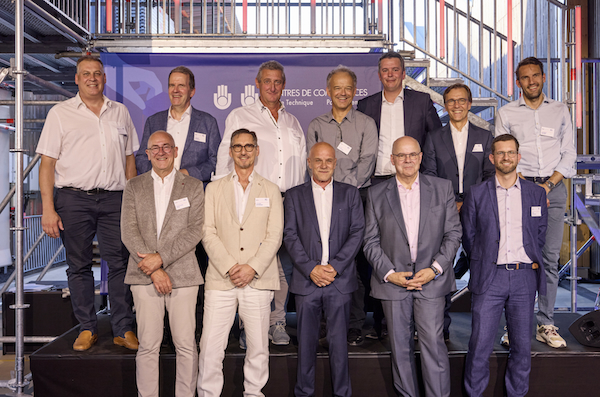
 (L-R): Luc Meyer, Clément Wampach, Romain Schmitt, Michel Reckinger, Lex Delles, Alex Kieffer, Laurent; Decker, Jean-Marie Jans, Claude Schreiber, Marc Herkes, Marc Spautz, Tom Girardin;
Credit: Centres de Compétences Luxembourg
(L-R): Luc Meyer, Clément Wampach, Romain Schmitt, Michel Reckinger, Lex Delles, Alex Kieffer, Laurent; Decker, Jean-Marie Jans, Claude Schreiber, Marc Herkes, Marc Spautz, Tom Girardin;
Credit: Centres de Compétences Luxembourg
Luxembourg’s Centres of Competence recently marked their tenth anniversary with an event entitled “Les Maîtres du Geste” (Masters of Gesture) which took place in Bettembourg, on Thursday 18 June 2026.
According to the Centres of Competence, more than 500 guests – political, economic, institutional, trade union and craft representatives – gathered for the event, which highlighted those who preserve and reinvent the mastery of professional skill every day and contribute to Luxembourgish excellence, and focused on the future, innovation and continuing vocational training, affirming the collective commitment to training future talent.
In his opening speech, Michel Reckinger, Chief Executive Officer of Reckinger Alfred SA, President of the Luxembourg Employers’ Association (UEL), President of FONGECO and former President of the Federation of Craftsmen, reflected on the origins of the Competence Centres, a project he has known intimately since its beginnings. He emphasised the importance of this initial vision, which has enabled the Centres to become key players in the Luxembourg ecosystem today.
Continuing this retrospective and looking towards the future, Marc Spautz, Luxembourg Minister of Labour, praised the “success story” of the Centres of Competence in the Luxembourg continuing vocational training landscape. He recalled that, in a context of rapid transformation of professions, “skills upgrading is an essential pillar to guarantee employability, competitiveness and social cohesion”. Minister Spautz also highlighted the importance of sectoral initiatives, which make it possible to rapidly adapt training to real-world needs.
Marc Herkes, President of the Centre of Competence for Finishing Works, a speech which paid tribute to all those who bring the Centres to life on a daily basis. He recalled that “nothing that exists here – the programmes, the models, the pathways – would exist without our teams”. He praised the work of the technical teams, as well as the commitment of all departments. He also proudly recalled that the Centres’ building received, in 2024, the prestigious Bauhärepräis from the Order of Architects and Consulting Engineers (OAI), a major recognition for Luxembourg craftsmanship and know-how.
The evening also featured a round table discussion dedicated to the future of vocational training and youth training brought together. Moderated by presenter and journalist, Raoul Roos, the discussion featured contributions from Lex Delles, Luxembourg Minister of the Economy; Laurent Decker, Director of Decker Ries and Vice-President of the Federation of Tilers, Masons and Stonemasons; Tom Girardin, Director General of the Centres of Competence; and Alex Kieffer, Director of Gabbana, President of the Technical Engineering Federation and Vice-President of the Chamber of Trades.
The speakers unanimously recalled that the Centres of Competence represent a true “win-win-win” for employees, companies and the Luxembourg economy. The success achieved by the Centres once again confirms the relevance of this model, which goes far beyond training alone: they also contribute to enhancing the craft sector and increasing its attractiveness.
The discussion also highlighted the need to continue this collective effort. Luxembourg can be proud of its craftsmanship and would benefit from drawing inspiration from neighbouring countries to further strengthen the promotion and enhancement of the sector, which is essential for the country’s economic and social future.
On the subject of labour shortages and employability, the speakers recalled that the shortage of skilled personnel is one of the sector’s major challenges. The Centres of Competence play a strategic role in strengthening employability, supporting business growth and ensuring the sustainability of the craft sector.
In relation to the energy transition, it was noted that this is profoundly transforming professions: photovoltaics, heat pumps, ventilation, hydrogen, intelligent energy management, and the Centres must support these changes by developing adapted training and anticipating future needs.
Looking to the future of the Centres of Competence, the participants stressed the need to strengthen infrastructure, expand the training offer and consolidate cooperation between public bodies, federations, companies and social partners.
In his closing speech, Claude Schreiber, President of the Centre of Competence for Building Technical Engineering, recalled that “training remains the key to competitiveness, innovation and sustainability”. He also announced two major projects: the construction of a new workshop with a 500 m² warehouse to integrate technical and technological equipment; and the construction of a new building including shared training rooms with the Building Inspection and Acceptance Service (S.C.R.B.) of the Chamber of Trades.
It was noted that these infrastructures will significantly expand the training offer – combustion boilers, heat pumps, ventilation systems, hydrogen, etc.
Claude Schreiber also confirmed that the Centres are actively working on a training project in the north of the country, in order to strengthen accessibility and proximity for companies and their employees.
The Centres of Competence emphasised that this anniversary evening demonstrated its strategic importance for the Luxembourg economy. In ten years, the Centres have become an essential player in continuing vocational training, a strong partner for companies and a driver of innovation for craftsmanship. With more than 90,000 people trained and more than 17,000 training sessions delivered, the Centres confirmed their central role in the continuing vocational training landscape, with a strong message: “Together, let us train the craft talents of the future.”