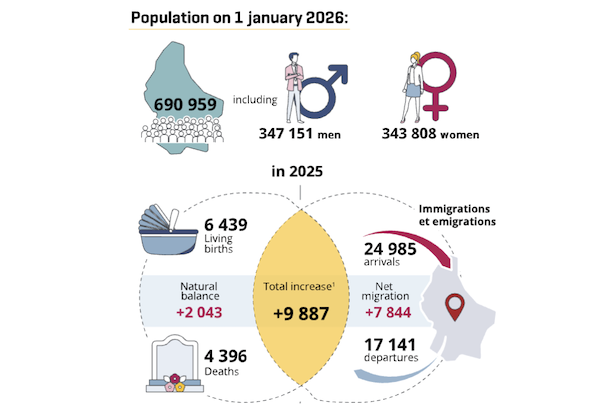
 Credit: STATEC
Luxembourg’s national statistics institute, STATEC, has published the country’s demographic figures for 2026; as of 1 January 2026, Luxembourg had a population of 690,959, an increase of 1.3% compared to 2025.
STATEC reported that this growth rate is lower than that observed a year earlier (1.5%) and significantly below levels recorded over the past decade (between 2.0% and 2.5%), as well as during the COVID-19 period (1.4% in 2020 and 1.7% in 2021).
The report also noted that population growth in 2025 was mainly driven by migration, with 24,985 arrivals and 17,141 departures recorded during the year. The natural increase (births minus deaths) stood at 2,043 people, compared to a net migration of 7,844.
Age profile
As of 1 January 2026, the average age of the population was 40.8 years for women and 39.5 years for men.
Foreign residents were significantly younger than Luxembourg nationals. The average age for Luxembourgish women was 42.2 years, compared to 39.3 years for foreign women. The difference was less pronounced for men, with the average age standing at 40.0 years for Luxembourgish men compared to 38.9 years for foreign men.
Low fertility
The number of births recorded in 2025 was slightly lower than in 2024, with 6,439 births compared to 6,459 the previous year (-0.3%). This slight decline, combined with population growth, resulted in a decrease in the total fertility rate, which stood at 1.23 children per woman in 2025, its lowest level on record. Luxembourg has seen a steady decline in its fertility rate since the early 2000s.
This trend is also observed across Europe. Within the EU-27, the total fertility rate fell from 1.43 children per woman to 1.34 between 2001 and 2024.
The fertility rate among Luxembourgish women remained particularly low at 1.16 children per woman in 2025, close to one child per woman. While this rate stabilised slightly compared to 2024, the fertility rate among foreign women declined to 1.35 children per woman, although it remained higher than that of Luxembourgish women.
Life expectancy remains high
In 2025, the number of deaths stood at 4,396, slightly lower than in 2024 (4,471), while the population increased by 1.3% over the same period. Slightly more male deaths (50.7%) than female deaths (49.3%) were recorded. Luxembourg nationals accounted for 75.1% of deaths, while deaths among foreign nationals represented 24.9% (1,095 deaths), reflecting the younger age profile of the foreign population.
The mortality rate continued to decline, falling to 6.4 per 1,000 inhabitants in 2025 (compared to 6.6 in 2024), following higher levels during the COVID-19 period.
The average age at death was 78.1 years, including 81.1 years for women and 75.1 years for men. Life expectancy at birth stood at 85.2 years for women and 81.1 years for men, with the gap between women and men continuing to narrow.
Immigration on the decline
In 2025, Luxembourg recorded 24,985 arrivals, down 2.9% compared to 2024, and 17,141 international departures, up 4.2%. Net migration stood at 7,844.
French nationals represented the largest group of newcomers (3,515), followed by Portuguese (3,147) and Luxembourgers (2,204). Among those leaving the country, Luxembourgers were the largest group (3,315), ahead of Portuguese (2,898) and French nationals (2,504).
In terms of net migration, French nationals recorded the highest positive balance, followed by Italians and Ukrainians. Luxembourgers, meanwhile, continued to show a negative net migration, with 2,204 arrivals compared to 3,315 departures.
Foreign population in Luxembourg
As of 1 January 2026, 322,050 foreign nationals were living in the Grand Duchy, 11.8% of whom were born in Luxembourg. As Luxembourg’s demographic growth is driven by migration, the share of foreign nationals remains significant at 46.6%, but has declined compared to 2025 (47.0%). This decrease is linked to lower immigration and continued naturalisations.
As of 1 January 2026, 180 nationalities were present in Luxembourg. Among the ten nationalities with the highest numbers, eight are from the EU. The largest non-EU community in this group is Ukrainian (6,028 people), followed by the Indian community (5,728).
Portuguese nationals remain the largest foreign community, accounting for 12.8% of the total population, followed by French (7.1%) and Italian nationals (3.7%). Together, these three groups represent just over half (50.6%) of the foreign population. They are followed by Belgians (2.6%) and Germans (1.8%).
There were 242,682 foreign nationals holding EU citizenship, representing 75.4% of the foreign resident population. Other groups included nationals from non-EU European countries (7.5%), Asia (7.5%), Africa (6.5%), and the Americas (3.1%), as well as a small number from Oceania. In addition, 268 stateless persons or individuals of unknown nationality were recorded.
Acquisition of Luxembourgish nationality
During 2025, a total of 8,223 people obtained Luxembourgish nationality, representing an increase of 10.9% compared to 2024. Most acquisitions were made through the option procedure (6,544 cases), followed by naturalisation (1,298) and restoration (381). Of these, 26.6% were granted to non-residents, an increase compared to 2024. Among this group, Brazilian nationals represented the largest share, followed by US and French nationals.
Marriages and divorces
In 2025, 2,604 marriages were celebrated in Luxembourg, an increase of 1.4% compared to 2024. Of these, 89 were between two people of the same sex, including 56 between men and 33 between women. The average age at first marriage was 33.2 years for women and 34.7 years for men.
The number of divorces stood at 1,367 in 2025, representing an increase of 14.2% compared to the previous year. The average duration of marriages dissolved in 2025 was 12.8 years.