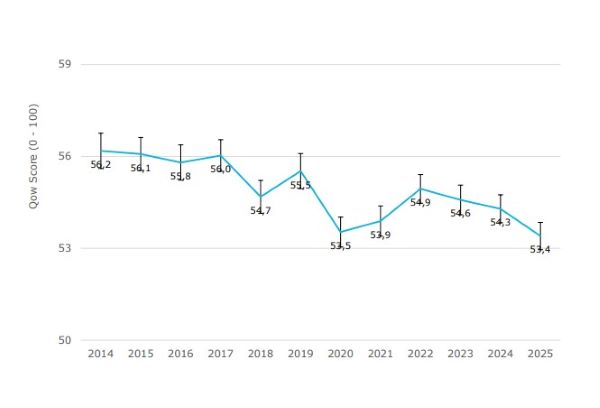
 The quality of work index in the scale from 0 to 100;
Credit: CSL
The quality of work index in the scale from 0 to 100;
Credit: CSL
On Wednesday 4 February 2026, Luxembourg Chamber of Employees (Chambre des salariés - CSL) released new survey data showing that the quality of work in Luxembourg has fallen to its lowest level since 2014, while also presenting proposals to reform vocational education and continuous training.
The “Quality of Work Index 2025” survey, undertaken in cooperation with the University of Luxembourg, was carried out by the Institute for Applied Social Sciences (infas), in Bonn, Germany and measured working conditions and well-being among employees and public sector workers in Luxembourg.
Results showed that the overall quality of work index fell to 53.4 points in 2025, marking its lowest level since 2014. This follows a sharp decline in 2020, a slight recovery in 2022 and a continuous downward trend through to 2025.
The study highlighted rising psychosocial and physical risks, increasing burnout and weakening access to positive workplace resources such as autonomy, feedback, participation in decision-making and continuous training.
The survey, conducted between June and September 2024 among 3,171 employees and public sector workers aged sixteen to 64, showed that only 29% of respondents reported having strong opportunities for continuous training, while 39% say their access remained very limited.
According to the data, training participation concentrated mainly on short, job-related courses, with ony 10% of participants taking part in long, diploma-granting programmes. Inequalities persisted across professions, with managers and highly qualified workers benefiting from far greater access than manual and service workers.
The aspect of physical health also declined over the period between 2014 and 2025. Reports of back pain increased from 28.3% to 33%, sleep disorders from 19% to 30.2%, headaches from 17.4% to 24.5% and joint problems from 18.7% to 23.3%. CSL attributed these trends to “chronic work-related stress”.
The Quality of Work Index further showed a total of 60.6% of workers reporting staff shortages in their sector, while 42.3% said these shortages have lasted longer than eighteen months. In cases of severe shortage, this figure rises to 67%, with hospitals, health and social care, hospitality industry and transport appearing among the most affected sectors.
These shortages directly impacted daily working conditions, where among affected employees, 61% said they must work faster, 55% reported increased overtime, 57% carried out tasks outside of their field of competence and 45% lacked time for continuous training. As a result, data showcased 38% of workers who were exposed to strong labour shortages considered leaving their job, compared with a national average of 26%.
Against this backdrop, CSL issued a position paper calling for reforms to initial and continuous vocational education, including changes to lower secondary education, expanded career guidance, generalised discovery internships, digitalised apprenticeship monitoring, formal recognition of workplace tutors, higher and harmonised apprenticeship allowances and a specific status for apprentices with disabilities.
For adult learning, CSL recommended creating a committee between three parties on continuous vocational training and introducing a genuine individual right to lifelong learning, alongside employer responsibility to allocate working time for training, improved financial support and personalised guidance.
Additional recommendations included strengthening the recognition of foreign qualifications, simplifying validation of prior experience, expanding diploma-granting training opportunities, modularising learning pathways, creating sectoral training centres and introducing a national quality system for continuous training.