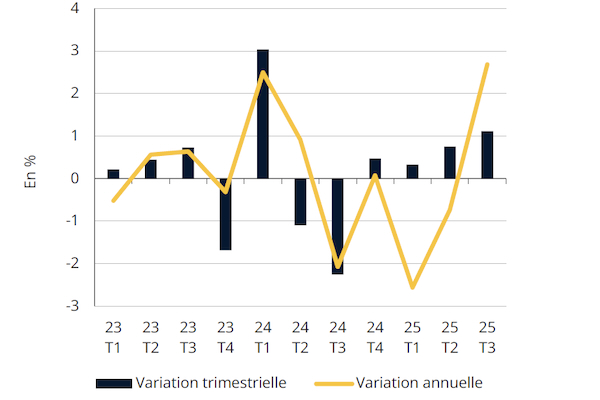
 Evolution of GDP in volume in Luxembourg;
Credit: STATEC
Evolution of GDP in volume in Luxembourg;
Credit: STATEC
On Tuesday 16 December 2025, Luxembourg’s national statistics institute, STATEC, published its latest Conjoncture Flash report, showing that real GDP grew by 1.1% in Q3 2025 compared with the previous quarter.
According to STATEC, this marks four consecutive quarters of growth since Q4 2024, a run not seen since 2019. Over the year, overall growth reached 2.7%.
STATEC highlighted that the financial sector was driven by stock market dynamism, the issuance of assets in collective investment undertakings, and new credit activity. In Q3 2025, value added by volume increased by 7.1% for auxiliary activities and by 2.9% for insurance services, while it fell slightly for banks (-0.5%).
Investment expenditure (gross fixed capital formation) increased sharply in Q3 2025 (+12% over the quarter), after a decline of almost 3% in Q2. This growth was largely driven by satellite and aircraft acquisitions, which also led to a marked increase in goods imports, neutralising the impact on GDP. Investment in metal products and machinery (excluding transport equipment) also contributed significantly to overall growth.
After two consecutive quarters of slight declines (-0.2% each), household consumption rebounded by +1.2% in Q3, particularly in catering services, capital goods (furniture and household appliances), transport services, and clothing. Public consumption remained dynamic, growing by +1.3%, in line with previous trends. Service exchanges, both financial and non-financial, also contributed positively to GDP growth.
STATEC noted that euro area GDP growth for Q3, initially estimated at +0.2%, was revised upwards to +0.3%. While results for major economies remained unchanged, smaller member states contributed to the revision. For example, Austria’s growth was adjusted from -0.1% to +0.4%.
Monthly business surveys cited several factors potentially affecting activity, including insufficient demand, labour shortages, and international trade tensions. The proportion of companies citing trade tensions as a binding constraint increased significantly in 2025, affecting both industry and services.
Average wage costs per employee rose by 4.9% year-on-year in Q3 2025, compared with 4.4% in Q2 and 2.8% in Q1. The acceleration is mainly due to the full impact of May indexation in Q3, contributing 2.5 percentage points to the annual increase.
The average age of Luxembourg’s population increased from 38 years in 2005 to 40 years in 2025. The working-age population has aged more slowly since 2011, rising from 41.0 to 41.6 years between 2005 and 2025, as most baby boomers (born 1945–1960) have already exited this age group. High immigration over the past 15 years has also kept the average age relatively low, as newcomers are younger, around 30 years on average.
Despite an ageing population, workforce participation among people over 55 has increased considerably, from 45.5% in March 2005 to 55.4% in March 2025. In March 2025, nearly 45,000 residents over 55 were employed in Luxembourg, representing 15.8% of total resident employment.