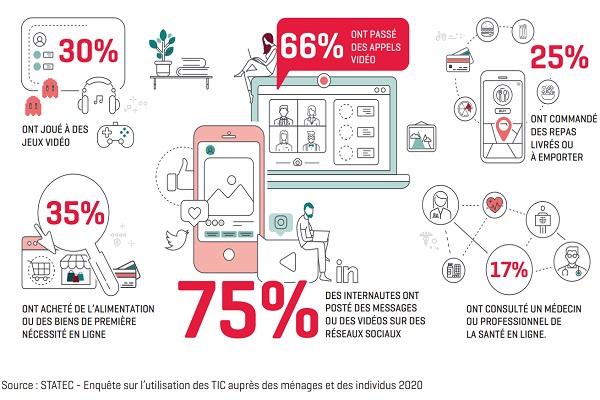
 Credit: STATEC
In its latest report, STATEC revealed that Luxembourg has experienced a huge surge in internet usage during the COVID-19 pandemic.
Confined to their homes, residents have never spent so much time on the internet. According to STATEC data on the private use of information and communication technologies (ICT) by households and individuals, 38% of internet users have posted messages or videos more often than before confinement. 60% bought more food or basic necessities online and 51% ordered more meals online. These figures show a clear change in internet usage and a sharp acceleration in the frequency of online services such as video calls or medical consultations.
Since the start of the pandemic, 66% of internet users in Luxembourg have made video calls for personal reasons (71% of women and 62% of men), compared to 55% before confinement. Across all age groups, the majority of internet users made video calls more often than before.
Similarly, 75% of internet users posted messages or videos on social networks to keep in touch with family or friends during the pandemic. Despite this activity being already widespread in normal times, 38% said they had posted more often than before confinement. Posts were a little more popular overall than video calls, especially among those aged 55 to 64, of whom 70% posted messages or videos compared to 47% who made video calls.
Online video gaming experienced a less dramatic shift than other online activities during this period: 30% of internet users played online during confinement. Whilst there were not more gamers than usual, almost half said they played more often than before. This hobby varied by gender and level of education: 39% of men, 21% of women, 35% of lower-educated and 24% of high-educated internet users played online during confinement.
Globally, 35% of internet users ordered food or basic necessities online during this period, of whom 60% did so more often than before. Internet users in employment were more likely to order food or basic necessities online than those not in employment (39% compared to 30%), as were those working from home (43% compared to 35% of those not working from home).
Likewise, 25% of internet users ordered takeout or home delivered meals online during confinement, half of whom used these services more often than usual. Again, working internet users (35%) and those working from home (36%) were more likely to use such services than the those not in employment (19%) and those not teleworking (24%).
66% of internet users made other online purchases than those mentioned above during confinement, with 38% buying online more often than before.
In addition, 43% of internet users used online services to contact public services or submit forms during confinement, of whom 31% used these services more often than normal. Online banking, which is already popular under normal circumstances (72%), also attracted more internet users (83%) during this period. The number of e-banking customers increased most significantly among 16 to 24 year olds (up 15%) and 25 to 34 year olds (up 18%).
Almost 6 in 10 people searched for health-related information online during confinment. Whilst the same number of people did this before the pandemic, 66% did so more often than usual. Similarly, 17% of internet users said they had consulted a doctor or healthcare professional online during this period. This was a common trend among all age groups but especially among 35 to 44 year olds.
Methodology
These figures are based on STATEC's community survey on ICT usage by households and individuals aged 16 to 74 years. It was carried out by the German company infas on behalf of STATEC from a sample of nearly 1,500 individuals according to a mixed-mode data collection scheme, combining telephone and internet.