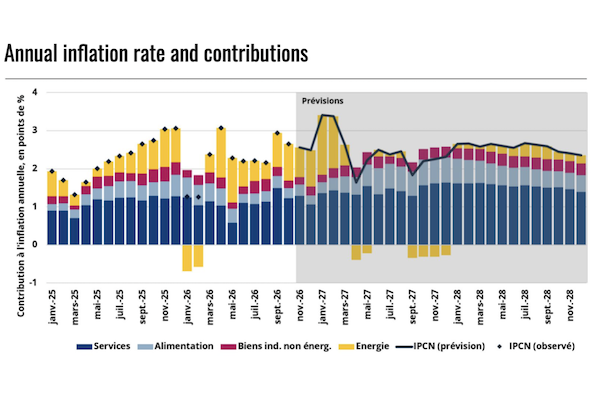
 Annual inflation rate and contributions (forecasts as of Wednesday 4 November 2026);
Credit: STATEC
On Wednesday 4 November 2026, Luxembourg's national statistics agency STATEC published its updated inflation forecasts for 2026-2028, projecting inflation of 2.3% this year and 2.5% in both 2027 and 2028, with the next wage indexation expected in the second quarter of 2027.
According to STATEC, the ongoing conflict between the United States and Iran has continued to disrupt global energy markets, with the Strait of Hormuz remaining almost closed to shipping. Brent crude oil averaged $106 per barrel in October, while markets now expect energy prices to remain high for an extended period. The inflationary shock, which the spring assumptions had confined to 2026, would thus extend into 2027, with inflation in the euro area not returning towards 2% until 2028.
Energy prices and inflation in the euro area
STATEC noted that Oxford Economics' international assumptions, updated in mid-October, now forecast Brent crude oil prices averaging $98 per barrel in 2026 and $96 in 2027, before declining to $73 in 2028.
In the euro area, inflation rose from 3.2% in August to 3.8% in September, driven by an 18.9% annual increase in energy prices. Inflation is now expected to reach 3.0% in 2026, remain at 2.7% in 2027 and fall to 1.8% in 2028. Food inflation is projected to accelerate from 1.8% in 2026 to 2.9% in 2027, while core inflation is expected to reach 2.7% in 2027.
Inflation in Luxembourg remains driven by energy
In Luxembourg, inflation stood at 2.7% in October, down from 2.9% in September. After exceeding 3% in April, it had fallen to around 2.2% during the summer before rising again alongside oil prices. Energy remained the main driver, accounting for approximately one percentage point of October's inflation.
The Resilienzpak support measures have only partially cushioned the increase in energy prices. Despite the €0.15 per litre discount introduced in August, heating oil cost €1.39 per litre in October, 68% more than in January (€0.83 per litre). Without the discount, the price would have reached €1.54 per litre, representing an 87% increase compared with January.
Diesel followed a similar trend. Despite the €0.05 per litre reduction, its average price reached €2.05 per litre in October, 47% higher than in January.
The impact on other prices has remained limited so far. Excluding energy, inflation remained below 2% in October. Food inflation, which reached 3% at the beginning of the year, had fallen to around 1.5%, while prices of non-energy industrial goods increased only slightly. Services contributed to September's inflation peak, notably due to volatile prices for childcare centres and passenger air transport.
Extension of energy support measures
Following tripartite discussions in June, the government and social partners introduced the Resilienzpak to mitigate the impact of rising energy prices. Since the summer, these measures have reduced energy prices including VAT by €0.05 per litre for diesel and petrol (since July), €0.15 per litre for heating oil, €0.04 per kWh for electricity and €0.15 per cubic metre for gas (since August).
According to STATEC, these measures have reduced inflation by 0.7 percentage points since August, equivalent to an average reduction of 0.3 percentage points in 2026.
The measures were initially scheduled to expire on 31 December 2026. However, on Thursday 29 October 2026, the Tripartite Monitoring Committee decided to extend support for electricity, gas and heating oil until 31 December 2027, while support for diesel and petrol will continue until the end of February 2027.
STATEC estimated that the extension would reduce inflation in 2027 by nearly 0.7 percentage points. Although it would have only a marginal impact on the timing of the wage indexation expected in the second quarter of 2027, it would prevent a second indexation from taking place during the same year.
The withdrawal of fuel support in March 2027 and the remaining energy support measures in January 2028 would subsequently raise prices, adding approximately 0.7 percentage points to inflation in 2028. Over the 2026–2028 period, cumulative inflation would remain virtually unchanged.
Inflation forecasts for 2027 and 2028
Under STATEC's central scenario, inflation in Luxembourg is expected to average 2.3% in 2026 and 2.5% in both 2027 and 2028.
Without the extension of the support measures announced on 29 October, inflation would have reached approximately 3.1% in 2027 and 1.9% in 2028. The projected stability at 2.5% over the two years therefore largely reflects the decision to defer part of the price increase until 2028.
Energy prices are expected to increase by 7.7% in 2026, driven by a 15.7% rise in oil product prices. Energy inflation would then fall to 2.1% in 2027 before rising to 2.7% in 2028 following the withdrawal of support measures.
Household gas prices are projected to increase by approximately 10% in 2027, from €0.92 to €1.01 per cubic metre, despite the continuation of the €0.15 per cubic metre subsidy. Electricity prices, meanwhile, are expected to decrease by around 9%, from €0.24 to €0.22 per kWh, before rising to €0.26 per kWh in 2028.
Inflation in services is forecast to increase from 2.5% in 2026 to 3.2% in 2027 and 3.5% in 2028. Food inflation is expected to reach 3.0% in 2027 and 2.7% in 2028, while inflation for non-energy industrial goods would remain around 1%.
Within 2027, inflation is expected to exceed 3% in January and February, reaching 3.5% and 3.4% respectively, before temporarily falling to around 1.7% in April. This would reflect a base effect unrelated to the support measures, as energy prices would be compared with those recorded at the beginning of 2026, before the conflict.
Based on these forecasts, the next wage indexation is expected in the second quarter of 2027, followed by another in the second quarter of 2028.
Alternative scenarios and wage indexation
Given the uncertainty surrounding energy prices, STATEC also presented two alternative scenarios.
Under the high scenario, which assumes prolonged disruption to energy supplies, inflation in Luxembourg would reach 2.9% in 2027 and 3.0% in 2028. Brent crude oil would average approximately $104 per barrel in 2027 and $82 in 2028. Wage indexation would take place earlier, in the first quarter of both 2027 and 2028.
Under the low scenario, which assumes a rapid normalisation of energy markets, Brent would average $75 per barrel in 2027 and $60 in 2028. Inflation would fall to 2.0% in 2027 before rising to 2.7% in 2028, above the central scenario, as the withdrawal of support measures would push up energy prices despite a continued decline in market prices. The next wage indexation would remain scheduled for the second quarter of 2027, while the following adjustment would be postponed until the third quarter of 2028.
Overall, STATEC's scenarios place inflation between 2.0% and 2.9% in 2027 and between 2.5% and 3.0% in 2028. All three scenarios anticipate a wage indexation during the first half of 2027, although the agency stressed that further developments in energy markets could alter these projections.