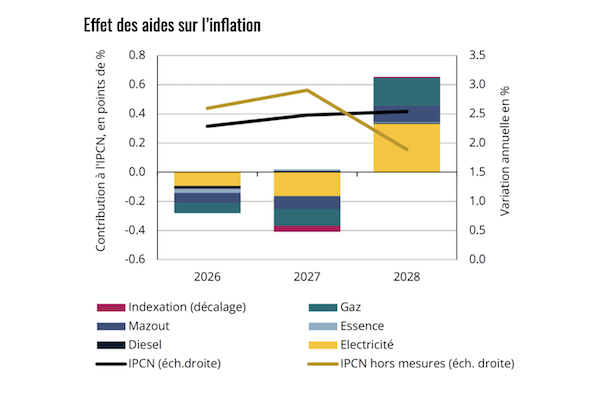
 Impact of energy support measures on inflation in Luxembourg (2026-2028);
Credit: STATEC
On Tuesday 24 November 2026, STATEC published its latest Conjoncture Flash report, indicating that the energy support measures under the Resilienzpak have reduced inflation by around 0.7 percentage points since August and delayed the next wage indexation tranche by several months.
Inflation and wage indexation
According to STATEC, to alleviate price pressures directly linked to the conflict in the Middle East, the government and social partners adopted a series of measures in June following the tripartite discussions, collectively known as the Resilienzpak. These measures reduce energy prices, including taxes, by €0.05 per litre for diesel and petrol (since July), €0.15 per litre for heating oil, €0.04 per kWh for electricity and €0.15 per cubic metre for gas (since August).
Initially scheduled to expire at the end of 2026, these measures were extended on 29 October by the Tripartite Monitoring Committee until 31 December 2027 for electricity, gas and heating oil, and until the end of February 2027 for diesel and petrol.
Without any measures, projected inflation would have reached 2.6% in 2026 and 2.9% in 2027, before falling back to 1.9% in 2028. The support measures also delay the wage indexation tranche. Without them, it would have occurred as early as the fourth quarter of 2026, but it is now expected in the second quarter of 2027.
STATEC noted that if all support measures had expired at the end of 2026, the price level would automatically have increased in January 2027, and inflation would have been around 3.1% in 2027, compared with 2.5% under the central scenario.
The extension should prevent a second wage indexation tranche from being triggered during 2027. However, it postpones the effect of withdrawing the measures. The expiry of fuel support measures will raise the price level in March 2027, while the expiry of the other measures will do so in January 2028, adding 0.6 percentage points to inflation in 2028. Over the entire 2026–2028 period, cumulative inflation would remain virtually unchanged.
Under the central scenario, inflation in Luxembourg would stand at 2.3% in 2026, followed by 2.5% in both 2027 and 2028. The next wage indexation tranche would occur in the second quarter of 2027, followed by another in the second quarter of 2028. STATEC noted that an easing of the conflict or a renewed escalation would significantly alter energy prices and, consequently, the trajectory of inflation and the timing of wage indexation tranches.
Labour market
According to the report, for the first time since the end of the health crisis, employment in the euro area is expected to stagnate in the third quarter of 2026, with year-on-year growth limited to 0.4%. This extends the slowdown observed since 2021 and contrasts with continued GDP growth, suggesting a recovery in productivity.
Meanwhile, the euro area unemployment rate rose to 6.5% in the third quarter of 2026, following its historical low of 6.2% at the end of 2024.
Construction
Confidence among Luxembourg construction companies continued to improve gradually in autumn, both regarding the state of order books and employment prospects. STATEC noted that this trend contrasts with those observed in neighbouring countries, where sentiment in the construction sector is deteriorating.
Since summer, confidence among construction companies in Luxembourg has been higher than in neighbouring countries.
Electric mobility
After stagnating in 2025, electric mobility returned to growth in Luxembourg in 2026. During the first nine months of the year, electric cars accounted for nearly one-third of new registrations, with a particularly marked acceleration in recent months. According to STATEC, this increase is probably partly attributable to rising fossil fuel prices resulting from the war in Iran, but also to the wider range of electric models available.
Electric cars have overtaken non-plug-in hybrids to become the most common powertrain among newly registered cars in the Grand Duchy. Conversely, the shares of diesel and petrol vehicles continue to decline. The market share of plug-in hybrids remains stagnant at around 5%.
However, the national vehicle fleet remains largely dominated by internal combustion engines. Petrol cars still account for 42% of the fleet, compared with 30% for diesel cars. The number of diesel cars has fallen by one-third over five years. Despite the recent increase in registrations, fully electric cars account for only 10% of the national vehicle fleet, while plug-in hybrids represent 4%.
Financial sector
At the end of September 2026, the net assets of undertakings for collective investment in Luxembourg reached €6,797 billion, an increase of 13% year-on-year. Following the marked rebound in the second quarter, driven by valuations (+€463 billion), their growth slowed in the third quarter (+€66 billion). The market effect turned negative again (-€25 billion), while net issuances, which remained positive each month, supported assets under management (+€91 billion).
Fees earned by depositary banks, which had benefited considerably from the strong performance of investment funds in the second quarter, are therefore expected to decline in the third quarter. STATEC noted that if the market downturn in November continues, it could weigh on the results of the entire financial sector in the final quarter.
Tourism
Overnight stays in tourist accommodation in the Grand Duchy increased by slightly more than 2% during the first nine months of 2026, broadly in line with trends observed in the United Kingdom, France and Germany.
In Luxembourg, the summer period produced mixed results in terms of tourist numbers. In each month from June to August, the number of overnight stays was below the levels recorded in 2025, both for hotels and similar establishments and for campsites. September offset these poor figures, with overnight stays increasing by almost 20% year-on-year and by more than 50% for campsites.
STATEC noted that precipitation was exceptionally low, making it the second-driest September since 1947, just behind 1959, while September 2025 had set a historical rainfall record.
Energy imports
During the first nine months of 2026, the European Union’s (EU) energy import bill increased by 24% compared with the same period in 2025, representing an increase of around €68 billion, while import volumes rose by only 2%.
More than 80% of this increase is attributable to crude oil and petroleum products, with Europe particularly exposed in relation to diesel, given that its refining capacity is insufficient to meet domestic demand. The remainder is attributable to natural gas, whose global prices have also increased during the year.
Although expenditure on energy imports currently remains below the record levels of 2022, STATEC noted that a prolonged conflict in the Middle East could extend this period of rising costs. Persistently high energy bills would then weigh on the EU’s trade balance and could also exert downward pressure on the euro.