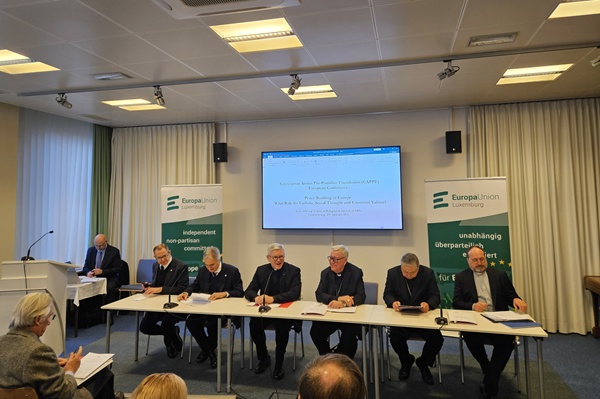
 Credit: Jazmin Campbell, Chronicle.lu
On Friday 23 January 2026, the Luxembourg School of Religion & Society (LSRS) hosted, for the first time, the European Conference of the Centesimus Annus Pro-Pontifice Foundation (CAPPF), centred on the theme "Peace Building in Europe: What Role for Catholic Social Thought and Universal Values?"
Co-organised by the CAPPF Luxembourg Chapter, the LSRS and the Commission of the Bishops' Conferences of the European Union (COMECE), the conference addressed a highly topical issue, placing universal values at the centre of peacebuilding in Europe and framing it as "a process of spiritual synodality".
The conference was held in English and French and brought together participants from Luxembourg and across Europe, with additional attendees joining online, including from North America. Queen Diambi Kabatusuila was among those present on-site in Luxembourg.
The introductory session featured welcome remarks from LSRS Director Jean Ehret, who presented the school as a theological institution of the Catholic Church where different religious affiliations work together under one roof, alongside non-theologians and practitioners. Other speakers included Christophe Déage, Chair of the Conference Steering Committee, Fr Manuel Barrios Prieto, Secretary General of COMECE, and Prof. Paolo Garonna, President of CAPPF.
A message from the Pope, offering his blessing, was read out, followed by a video message from European Parliament President Roberta Metsola, who recalled that the European Union is fundamentally a peace project rooted in shared values such as human dignity, solidarity and democracy. She stressed that peace remains a shared responsibility requiring collective effort.
In his inaugural keynote speech, Cardinal Jean-Claude Hollerich, Archbishop of Luxembourg, spoke of a "change of era" and the need for a comprehensive global to contemporary challenges, alongside targeted solutions to specific problems. He emphasised the importance of dialogue, moral strength and universal values such as human rights, international law and multilateralism. Commenting on recent discussions on rearmament, he said that military capacity alone would not guarantee security and that peace also requires people willing to defend freedom. He also highlighted the synodal experience of the Church as a model for dialogue and participation in an increasingly polarised world.
In her keynote address, Gelsomina Vigliotti, Vice-President of the European Investment Bank (EIB), focused on Europe's role in supporting Ukraine. She noted that the EIB has provided the country with €4 billion in financing, aimed at helping Ukrainians maintain essential services and strengthening the country's resilience and reconstruction capacity.
The morning continued with a plenary session on "Ways for peacebuilding and recovery in Ukraine and Eastern Europe", moderated by Christophe Déage. Speakers included: Mariano Crociata, Chairman of COMECE Brussels; Halyna Yanchenko, Ukrianian MP and Secretary of the National Investment Council of Ukraine; Bernad Snoy, Chairman of the Robert Triffin International Foundation; and Fr Oleh Zymak, a priest of the Ukrainian Greek Catholic Church.
Halyna Yanchenko's account of daily life in Ukraine, marked by power cuts, drone attacks and hardship for civilians, particularly vulnerable groups, resonated strongly with the audience. Calling for concrete decisions and rapid action rather than expressions of sympathy, she stressed that peace cannot be achieved through force or imposed at the expense of justice. Her interventions was met with prolonged applause.
Fr Oleh Zymak similarly delivered an emotional appeal for solidarity with Ukraine, underlining the fragility of international institutions and the need to uphold human dignity and a fair peace. Other speakers highlighted the importance of dialogue, cultural understanding and shared responsibility in countering populism and strengthening collective sovereignty.
The programme continued with parallel sessions and additional keynote addresses, with the concluding plenary session scheduled to end around 17:30. The day also included coffee breaks, a light lunch and a closing cocktail.