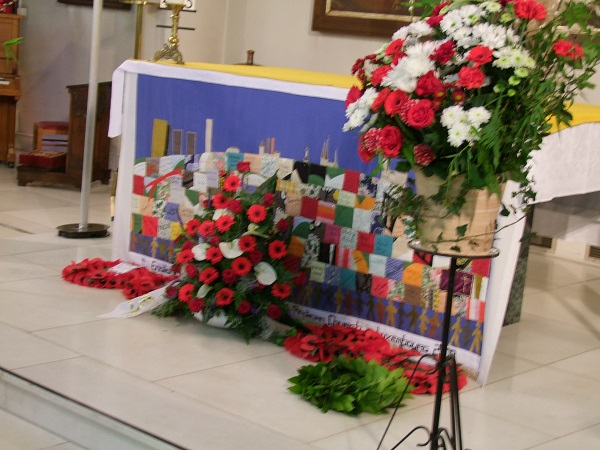
On Sunday morning, the Anglican Church in Luxembourg held its annual Service of Remembrance.
At the start of the service, wreaths were laid by Alice Walpole (British Ambassador to Luxembourg), Peadar Carpenter (Irish Ambassador to Luxembourg), Christine Gläser (German Ambassador to Luxembourg), Atsuko Nishimura (Japanese Ambassador to Luxembourg), Alison Shorter-Lawrence (Chargé d'Affaires ad imterim at the US Embassy in Luxembourg), Collette Mart (Alderman at the Ville de Luxembourg) and representatives of the British Armed Forces, the Royal Air Force Association and the Western Front Association.
Members of the congregation then participated with John Overstall reading the Act of Remberance and Frazer Alexander playing the Last Post and the Reveille on a bugle, with Ambassadors Christine Gläser and Alice Walpole reading lessons underlining the theme of reconciliation. The service also included various musical items directly linked to WW1 and WW2: De Profundis by l’Abbé Jean-Pierre Schmit, director of music at the Cathedral Notre Dame de Luxembourg, was written while he was interned in the concentration camp at Hinzert; Alan Carlisle, the Anglican Church of Luxembourg's former Director of Music has set to music the poem “Secret Music” by the WW1 war poet Siegfried Sassoon; and the English translation of the poem “Von guten Mächten wunderbar geborgen”, which was written by Dietrich Bonhoeffer in his prison cell just a few months before his execution in May 1945 for his part in the plot to assassinate Adolf Hitler, was also sung.
With many of the congregation wearing poppies in solidarity, the service gave thanks for the sacrifice of so many men and women in the wars of the last century, as well as praying for peace and reconciliation.
In his sermon, the Rev’d Chris Lyon asked how it might come about that nations would not make war anymore. He said that we should affirm the common humanity of everybody and not believe that we were superior because of our race, culture or religion. Jesus made no distinctions between people, whether or not they were his followers.
He spoke about not all heroes being saints and not all our (British, in this case) history is umblemished. He referred to parts of history not well known including the Bengal famine of 1943, explaining that it is easier to focus on our heroes. He also referred to war being a profitable business for some, referring to the industrial side of war. As well as WWI and WWI he also referenced the Falklands War and others. He said that generally we go to war by making mistakes, but often make it look like a deliberate act. Today we celebrate the sacrifices of men and women who, in extraordinary circumstances, gave themselves to their country, their neighbours, their community and to people they know and love. "We are all human and excercise our humanity".
Chris Lyon spoke of the courage of some of the soldiers of the WWI who had risked their lives for their comrades and been awarded the Victoria Cross; also, that many were astonishingly brave but not all were military. He then went on to speak of civilian courage and cited the example of how British nurses, Vera Brittan and Edith Cavell, treated the British and German wounded exactly the same. Vera Brittain went on to write the best-selling Testament of Youth set during WWI
He also spoke about two German men: Dietrich Bonhoeffer, and Hermann Maas. Maas was pastor of the Holy Ghost Church in Heidelberg, from 1915 until 1943. From the start he befriended the Jewish community, and spoke out against Nazi policies until he was forced to resign in 1943. During that time he rescued very many Jewish people. After imprisonment and forced labour, he was restored to his post in 1945, and served another 20 years.
These four people, inspired by Jesus, said Chris Lyon, showed how we might live, as humans together on this planet.
The service also includes the Act of Commitment which referenced humnanity.
Photos by Geoff Thompson