 Credit: St George's International School, Luxembourg
On Thursday 15 October 2026, St George's International School in Luxembourg-Hamm reported on the launch of its new sustainability theme, “Ice, Space and Finite Resources”, with an event involving experts from the International Polar Foundation and ESERO Luxembourg.
According to the school, more than 100 people attended an evening of polar science, space exploration and climate discussion on Tuesday 13 October 2026. The event featured a screening of the documentary 2050 by Eric Goens and Kristof Van Den Bergh, which explores the rapid melting of Antarctic ice, climate science and global planetary tipping points.
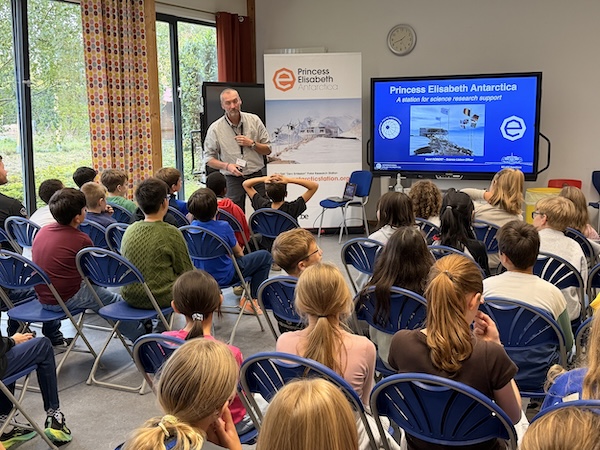
Earlier that day, International Polar Foundation Science Liaison Officer Henri Robert worked with Year 13 geography students to explore Antarctic research, ice melt and climate change. Students learned how the zero-emission Princess Elisabeth Antarctica research station operates and heard about plans for the proposed Andromeda Earth Observatory.
Henri Robert later challenged Year 6 students to imagine how the future station's interior could be designed for sustainable living in an extreme environment.
During the evening event, International Polar Foundation Managing Director Nicolas Van Hoecke and Henri Robert discussed research in Antarctica and the ambitions behind Andromeda. Frédéric Conrotte of ESERO Luxembourg explained how Copernicus satellite data can help scientists observe changes taking place across the planet.
Nicolas Van Hoecke explained: "Part of the International Polar Foundation's core mission is to educate future generations about the importance of polar science and learning to live in a more sustainable way, as we do at the Princess Elisabeth Antarctica, the world's first zero-emission polar research station. We're happy that St George's wants to teach these important values to its student body."
According to St George's International School, the event marked the beginning of a year in which students will investigate a common challenge linking Antarctica, space exploration and everyday life on Earth: how to live well when resources are finite. Through practical STEM and sustainability projects, students will explore how careful use, reuse and closed-loop thinking can turn that constraint into an opportunity for innovation.