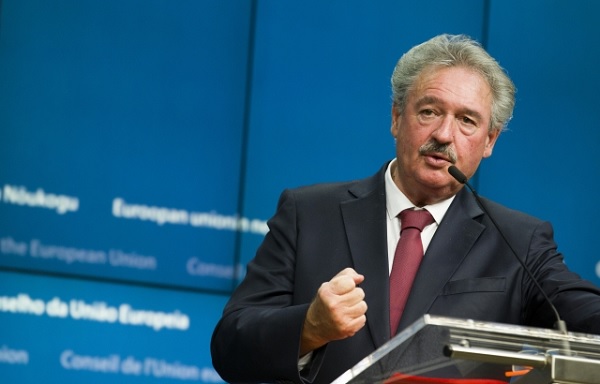
On Friday 4 December 2015, the migration policy meeting of the 'Justice and Home Affairs' (JHA) Council of the European Union (EU) took place in Brussels, chaired by Luxembourg's Jean Asselborn.
The Minister of Foreign and European Affairs, Minister of Immigration and Asylum, first briefed the Council on his recent visit to Athens, where he engaged in discussions with officials from the Greek Government, the European Commission, the United Nations High Commissioner for Refugees (UNHCR) and Frontex. Minister Asselborn spoke of efforts made by the Greek authorities to establishment hotspots as the country continues to face a massive influx of migrants.
The Council then held a detailed discussion on the situation of the migration crisis, monitoring EU measures already in place and to be taken to preserve the integrity of the Schengen area, on the basis of two documents submitted by the Luxembourg Presidency.
"Today, all Member States have expressed their commitment to the common area," commented the Ministers, adding that "Schengen will only work if the rules are followed." Ministers called for enhanced coordination ahead of nation decisions of temporary reintroduction of internal border controls, before emphasising the important of dealing with deficiencies in the control of external borders, welcoming the deployment of Rapid border intervention teams (RABITs) in Greece. Ministers discussed the temporal limits of the reintroduction of internal border controls on the basis of national decisions.
Ministers agreed that if serious deficiencies, jeopardising the functioning of the Schengen area, are recognised on the basis of objective facts in their evaluation, there should be a common European framework to contrinue certain controls stretching beyond six months, within the context of Article 26 of the Schengen Borders Code and on the recommendation of the Commission.
The Council meeting also led to the adoption of conclusions on statelessness, inviting the Commission to set up a platform for the exchange of best practices and information between Member States to contribute to the challenge of eradicating statelessness.
"We decided to work together on behalf of those who do not have rights, those who elude social coverage; stateless persons," remarked Jean Asselborn. "UNCHR launched a statelessness eradication campaign and we will contribute to this challenge."
The Council was also able to find a political agreement on the student/researcher Directive, which could allow more than 250,000 young people to benefit from new terms of admission into the European Union.
"I am convinced of the added value of this new instrument and the beneficial consequences it will have," Minister Asselborn continued. "This directive will allow the European Union to become more accessible and attract more young talents in Europe, which will allow us to invest in the future."
On the sidelines of the Council, the Luxembourg Foreign Minister attended the signing of the cooperation agreement on the exchange of personal data between Frontex and Europol. The agreement represents a step forward in terms of information exchange between European agencies and allows for operational cooperation. The agreement will provide close cooperation and integration action between the two agencies, particularly regarding hotspots. Minister Asselborn was of the opinion that "the agreement in question will certainly act in favour of the implementation of the decisions we have taken in recent months on migration".
Photos by European Union (Top: Jean Asselborn. Bottom clockwise: Dimitris Avramopoulos, European Commissioner; Jean Asselborn; Fabrice Leggeri, Frontex Executive Director; Rob Wainwright, Europol Director)