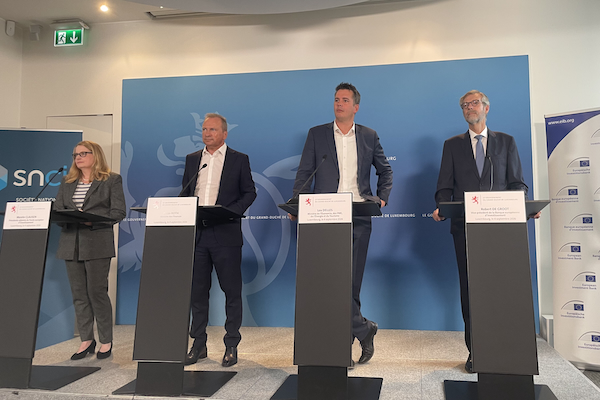
 (L-R) Merete Clausen, Deputy Chief Executive of the European Investment Fund; Gilles Roth, Luxembourg Minister of Finance; Lex Delles, Luxembourg Minister of the Economy, SMEs, Energy and Tourism; Robert de Groot, Vice-President of the European Investment;
Credit: Steven Miller, Chronicle.lu
(L-R) Merete Clausen, Deputy Chief Executive of the European Investment Fund; Gilles Roth, Luxembourg Minister of Finance; Lex Delles, Luxembourg Minister of the Economy, SMEs, Energy and Tourism; Robert de Groot, Vice-President of the European Investment;
Credit: Steven Miller, Chronicle.lu
On Friday 4 September 2026, Luxembourg’s Ministry of Finance, Ministry of the Economy, the National Credit and Investment Company (SNCI), the European Investment Bank (EIB Group) and European Investment Fund (EIF) held a press conference at Hôtel Saint-Augustin in Luxembourg-Ville where they presented details of Luxembourg Future Fund 3 (LFF 3).
The press conference featured contributions from Luxembourg’s Minister of Finance, Gilles Roth and Minister of the Economy, SMEs, Energy and Tourism, Lex Delles, as well as Vice-President of the European Investment Bank, Robert de Groot, and Deputy Chief Executive of the European Investment Fund, Merete Clausen.
According to the ministries, LFF 3 is intended to contribute to the diversification of the Luxembourg economy and strengthen the country's attractiveness by supporting innovation, investment and the development of businesses and startups, and will focus on specialised and multi-sector funds focused on high-growth sectors essential to the country's future, particularly in high-growth areas such as cybertechnology, fintech, health technology, space technology and transport logistics. The programme is intended to primarily support investment funds established in Luxembourg whose investment teams are already, wholly or partially, based in the Grand Duchy or commit to establishing themselves in Luxembourg.
LFF 3 sees the fund capacity continue to increase from previous iterations, rising from €200 million (LFF 2) to €270 million, following an initial rise from €150 million from LFF [1]. LFF 3 also sees a change to the management of the programme with SNCI now directly involved in the investment process following the EIF’s exclusive management of the two previous funds.
Minister Roth emphasised LFF 3’s flexibility, through its ability to invest in venture capital, private equity and debt, as well as its focus on specialised and multi-sector funds. The minister also highlighted SNCI’s increased involvement and noted the “strengthening of its relationship” with the market and how it will bringing its own expertise to the programme.
Minister Delles added that LFF 3 will help to “bring innovation to Luxembourg” and attract a variety of activities that will bring their own know-how to the country.
Robert de Groot detailed how LFF 3 “marks another important milestone in the long-standing partnership between the Luxembourg government, SNCI and the European Investment Fund” and how the relationship with these programmes is “about trust, about long-term commitment and building a successful innovation ecosystem”. He added: “[It] creates lasting values for Luxembourg by attracting talent, mobilising additional private investment and strengthening the ecosystem.”
Merete Clausen remarked: “I am confident, I am sure that Luxembourg will continue to play a leading role in shaping Europe's innovation and investment landscape. And I'm sure that in a few years from now, we will look back at LFF 3 as another stepping stone in a partnership between the EIB Group and Luxembourg that continues to strengthen Luxembourg's economy but also Europe's innovation ambitions.”
About the SNCI
The National Credit and Investment Company (SNCI) is a public-law banking institution specialising in medium- and long-term financing for Luxembourg companies. It specialises in supporting businesses at every stage of their life cycle by providing loans to cover part of the financing for their creation, development, transfer, or innovation projects. The SNCI may also acquire and manage stakes in companies and investment funds of strategic importance for the development and diversification of the Luxembourg economy.
About the EIF
The European Investment Fund (EIF) is part of the European Investment Bank Group. Its primary mission is to support European micro-enterprises and SMEs by helping them access finance. The EIF designs and deploys venture capital, growth capital, guarantee, and microfinance instruments specifically for this market segment. Through its work, it promotes the achievement of EU objectives for innovation, research and development, entrepreneurship, growth and jobs.