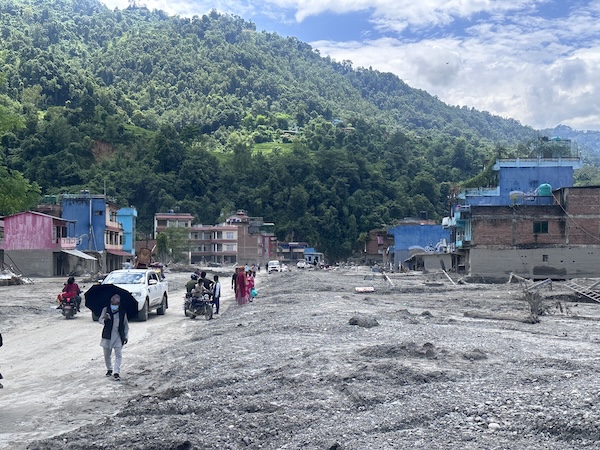
 Nepal, Rasuwa District, devastating flooding, August 2026;
Credit: SOSVE Nepal
Nepal, Rasuwa District, devastating flooding, August 2026;
Credit: SOSVE Nepal
On Friday 4 September 2026, Luxembourg-based SOS Villages d'Enfants Monde (SOSVEM) reported that its sister association in Nepal had launched its first emergency response measures for children and families affected by the devastating floods, with a new eighteen-month project set to support 5,980 people in the districts of Rasuwa, Nuwakot and Dhading.
According to SOSVEM, more than a week after the floods devastated parts of Nepal and Tibet, the death toll had risen to 1,280, with more than 5,600 people reported missing as of the evening of Thursday 3 September 2026.
In Nepal, an estimated 1.6 million people have been affected by the disaster and fifteen municipalities have declared a state of emergency. Humanitarian organisations estimate that 65,000 people require emergency assistance related to water, hygiene and sanitation, while more than 22,000 children need protection and humanitarian support. More than 100 children are believed to have been separated from their parents or guardians as a result of the disaster.
SOSVEM noted that its sister association has been present in Nepal for 54 years and currently supports thousands of children, young people and adults across seven provinces, including Bagmati, where some of the districts hardest hit by the mudflows are located.
Working alongside local authorities and partners, SOS Villages d'Enfants in Nepal is focusing its response on protecting children, particularly those who have been separated from their families, and supporting affected households. The organisation said the aim is to protect children's rights, improve their well-being and strengthen family resilience through humanitarian assistance and support for the early recovery of communities.
Following assessments on the ground, an eighteen-month intervention is beginning this September in Rasuwa, Nuwakot and Dhading. The project will combine emergency humanitarian assistance with early recovery support, with a particular focus on child protection. Around forty separated or unaccompanied children could receive temporary alternative care, while two child-friendly spaces are expected to open.
The response will cover three main areas. Protection and mental health support will target 1,330 people and will include child-friendly spaces, recreational and educational activities, psychological first aid, mental health counselling, family tracing and reunification, and alternative care where necessary.
Basic services will target 3,200 people and will include emergency shelter materials, food and non-food items, hygiene supplies, water and sanitation services, nutritional support and financial assistance.
Education and early recovery measures will target a further 1,450 people. Planned actions include temporary learning centres, the distribution of school supplies and winter equipment, the rehabilitation of schools, support for restoring livelihoods and measures to prepare communities for future disasters.
During the first months, the organisation plans to identify affected families, distribute essential supplies and implement child protection measures. Child-friendly spaces and mental health and psychosocial support activities are also expected to begin.
Those wishing to support the organisation's emergency response in Nepal can make a donation via https://sosve.lu/.