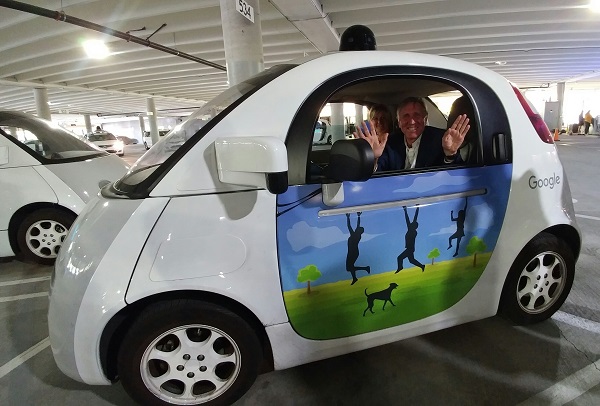
In early September, François Bausch, Luxembourg's Minister of Sustainable Development and Infrastructure, Francine Closener, Secretary of State at the Minister of Economy, and Camille Gira, Secretary of State at the Ministry of Sustainable Development and Infrastructure, travelled to Silicon Valley in California in order to learn about the latest developments in the field of autonomous driving - cars without a driver - and strategic partnerships.
The three Luxembourg government representatives met the main players in electromobility, mobility on demand and especially regarding autonomous driving. Alongside internationally renowned companies like Tesla, Google, ... Delphi, the delegation also visited the Plug and Play incubator and a number of promising start-ups in the field of transport.
A profound change in mobility through autonomous driving
Minister Bausch considered autonomous driving will profoundly change mobility and offer many possibilities to use road vehicles much more efficiently. "The behaviour of human beings is now the most critical factor in terms of accidents on the roads. Autonomous driving without drivers will have a positive impact on road safety. In the long term, the combination of electric and autonomous vehicles will lead to an efficient use of charging infrastructure and contribute to the decarbonisation of transport. Possible routes holdings of autonomous driving without drivers are multiple services from supply to demand, optimised vehicle sharing, a public space dedicated to reducing individual mobility and optimised traffic flows on road networks that are currently highly sought by vehicles occupied by a single person. So, given the potential related to autonomous driving without a driver, I am confident that Luxembourg should be a contact for emerging companies in the field of autonomous driving while keeping in mind to integrate them into multi-modal transport strategy."
Mobility as a Service
Secretary of State Closener underlined the power of innovation of the companies visited and economic opportunities for Luxembourg: "In Silicon Valley, autonomous cars are already a reality. Although at the prototype stage, these vehicles are everywhere in the streets and rapid advancements in technology are impressive. Luxembourg has a card to play as a living laboratory and economic partner in Europe. The efforts made in recent years will bear fruit and we expect to capitalise in particular by attracting business and US start-ups on the new campus in automotive development in Bissen."
Secretary of State Camille Gira believes that thanks to technological developments such as autonomous driving without driver and mobile applications related to transportation, members of the public will have the opportunity to move from vehicle owners to simple users. Thus, mobility as a service represents a sustainable mobility ecosystem where the citizen chooses a combination of transport modes suitable at best for his daily mobility needs. "Autonomous driving without driver is likely to strongly reinforce this trend by offering new possibilities for alternative modes of transport such as car sharing and carpooling and thus contribute to a more efficient use of energy resources that goes hand in hand with a reduction in CO2 emissions from the transport sector."
In May 2016, the Government cabinet decided to add to the priorities already identified as part of the Digital Lëtzebuerg development of Luxembourg as a living laboratory of mobility in close cooperation with the private sector. To support this approach and facilitate pilot projects, an interdepartmental committee under the co-chairmanship of the Ministry of Economy and Ministry of Sustainable Development and Infrastructure was created.
Luxembourg, an ideal laboratory for innovative technologies
Luxembourg has many advantages to offer to companies active in the field of smart mobility. An integrated ecosystem, its strategic position in the heart of Europe, its open economy and its multicultural population make Luxembourg an ideal laboratory for all kinds of solutions before deployment in European markets. Technological innovation is supported by, among others, an innovative automobile industry, excellent transport infrastructure and mobility strategies and ambitious digitisation. Flagship projects such as installation of public infrastructure of 1,600 charging points for electric vehicles, High Performance Computing, the new "Open Data" portal and the development of an automotive campus underline the government's commitment to position Luxembourg as a European leader in intelligent mobility.
The meetings were fruitful and Luxembourg's efforts were recognised by the American interlocutors who perceive the Grand Duchy as a reliable and innovative partner in Europe. Many collaborative ideas were discussed and will be deepened in the weeks and months ahead. The implementation of pilot projects offering intelligent mobility solutions in Luxembourg and creating economic activities in its territory were at the centre of exchanges between actors on both sides of the Atlantic.
Photo by MDDI