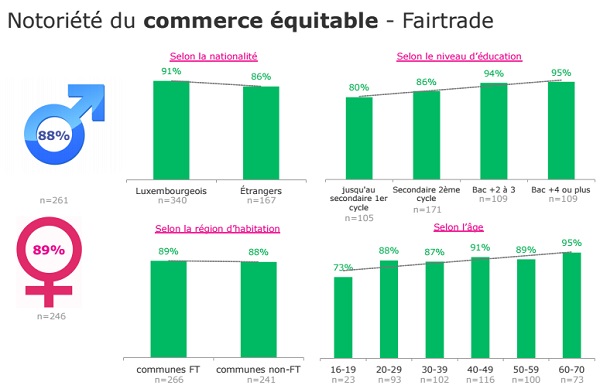
To mark nearly 25 years since the first Fairtrade coffee packet appeared on the Luxembourg market, Fairtrade Lëtzbuerg and TNS Ilres conducted a survey amongst the country's population to determine how the movement has progressed.
89% of respondents claimed to have already seen, read or heard talk of Fairtrade, whilst 94% said that they have already seen the Fairtrade label, with 83% describing themselves as familier with Fairtrade products.
Unsurprisingly, flagship Fairtrade products - chocolate, bananas and coffee - figure amongst the most consumed products. The movement does appear to have gained momentum, with 72% of those questioned who use Fairtrade products finding the bananas of excellent or very good quality, and 8 out of 10 people who do not currently consume such products stating themselves as willing to do so in the future.
66% of respondents demonstrated a reliance on Fairtrade products, citing their two primary concerns when opting to consume Fairtrade as being the prohibited use of child labour and guaranteed minimum wage for producers. The third pillar on which the Fairtrade movement is premised, that of ecology, also figured highly amongst the concerns of consumers.
89% of those surveyed explained that the reason behind their Fairtrade choices was motivated by social responsibility, compared with 53% who cited the same reason in a similar 2012 study. Fairtrade Lëtzebuerg claimed that this confirms the importance of its awareness campaigns, designed to show the unequal working conditions experienced in the global market. The availability of products on the market was also seen as a bigger motivator for people than in 2012, with 70% using it as a relevant market against 27% three years prior.
However, there was a certain reticence amongst 24% of respondents who claimed that they would still favour their own, known brands over Fairtrade products. Considering that 70% of respondents are aware of the consequences of purchasing conventional products in the South, Fairtrade Lëtzebuerg concluded that big brands should be urged to change their policies in order to cater to consumer demands, by abolishing trade practices which exploit both children specifically and human generally.
Half of respondents revealed that food is sold at their workplace, of which only a third provide Fairtrade products, despite the fact that 90% of the latter are satisfied with the products provided. In addition, around 50% from amongst the other two-thirds showed an interest in this becoming a reality at their workplace.
Those surveyed cited the government as the most important actor in promoting and helping to develop the Fairtrade movement, followed by public authorities, with Fairtrade calling for an overhaul to the whole supply process. The NGO claimed that the movement holds huge potential in terms of business and catering and pledged to motivate key players to adapt to customer and employee demands alike.
There are now 1,226 Fairtrade-certified organisations present across 74 countries in Africa, Latin America and Asia, covering 1.6 million producers.
Graphy by TN ILRES/Fairtrade Lëtzbuerg