 Credit: MMTP
On Wednesday 23 August 2023, Luxembourg's Ministry of Mobility and Public Works, together with the Ministry of the Interior, published new ministerial guidelines for traffic calming.
François Bausch, Deputy Prime Minister, Minister of Mobility and Public Works, presented the new ministerial guidelines grouping together the best practices applicable to traffic calming in built-up areas. During the press conference, Taina Bofferding, Minister of the Interior, took the opportunity to provide details on the urban planning component, one of the key elements of a peaceful neighbourhood.
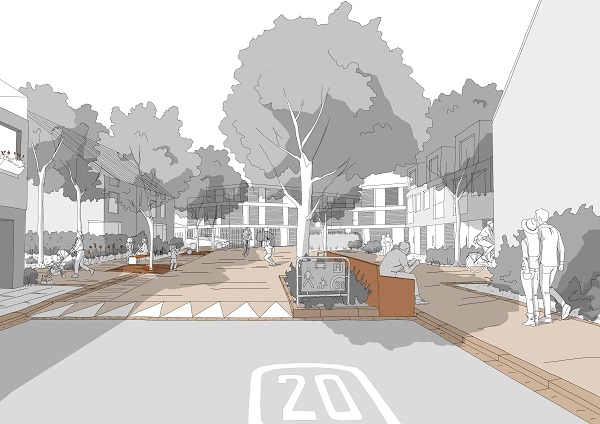
Traffic calming within built-up areas is to be achieved through the implementation of a set of measures aimed at reducing the speed and volume of motorised traffic at a certain location, while providing citizens and citizens attractive alternatives to using the car for short trips. The aim is to improve road safety, encourage walking and cycling and create welcoming public spaces.
Minister Bausch underlined: “We must stop designing public space solely from the motorist's point of view. Especially for short-distance journeys, everyone should be able to walk or cycle comfortably, safely and directly from home to any other destination within built-up areas.”
The calming of traffic inside urban areas also contributes to improving the quality of life within neighbourhoods. In this vein, the Ministry of the Interior has contributed to this new edition of the guidelines so that they take into account urban planning and landscape considerations when developing new districts.
Minister Bofferding added "The public space must also be designed as a space for living together, constituting a meeting place and social exchange for all in order to strengthen social cohesion in the towns and villages which have tendency to densify rapidly. Traffic calming thus contributes to improving our quality of life.”
The new guidelines come from an update of the brochure "Traffic calming inside built-up areas", which was published in 2013, and are supplemented by the guidelines of the brochure "Traffic calming on the state roads”, which dates from 2022.
The main new points are as follows:
- Provide municipal officials, who alone have the initiative for traffic regulations within agglomerations, with a single publication concerning the calming of both municipal and state roads.
- Design traffic calming not only as a measure to reduce the speed of motorised traffic, but also as an improvement in alternatives to the private car for travel on foot or by bicycle within built-up areas.
- Better integrate urban planning and landscape considerations when developing new districts.
- Substantially broaden the possibilities of calming on state roads. Thus, the possibilities of calming are now less defined by the status – municipal or state – of the road, than by its functional classification in the road network, as elaborated by the National Mobility Plan 2035.
- Draw lessons from experiences in the Grand Duchy of Luxembourg and international best practices, discarding certain recommendations that have proven to be ineffective while recommending arrangements, such as crossing sidewalks, which have proven their worth.
Composed of 15 thematic sheets, these guidelines, published in a first phase in French, will be made available to municipalities and their consulting firms, so that they have a single reference on the subject, and can be downloaded from the website www.apaisement.lu. The first sheet (A01) summarises the objectives of traffic calming inside built-up areas and gives a general overview of the organisation of the guidelines. Sheets A02 – A04 address the topics of traffic calming in new residential neighbourhoods or on existing roads and its application according to the functional classification of the road network. Sheets A05 to A10 present the different types of calming as well as the layout characteristics. Finally, sheets A11 to A15 develop the technical aspects of traffic calming and provide information on the procedures which differ depending on whether it is a state road or a public road.
The State Traffic Commission was commissioned to develop these guidelines. Chaired by the Department of Mobility Planning of the Ministry of Mobility and Public Works, a dedicated working group worked closely with the Roads and Bridges Administration and took advice from the Department of Municipal Planning and urban development of the Ministry of the Interior.