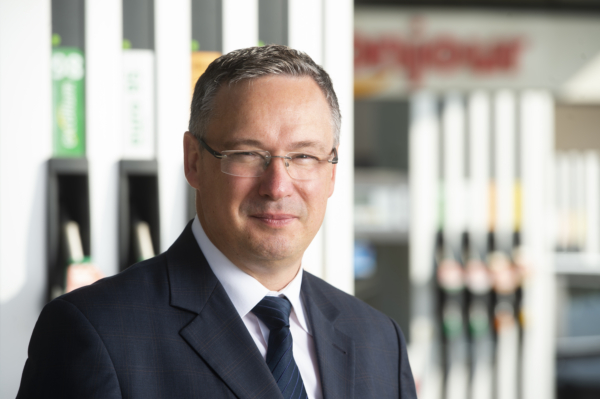
 Patrick Schnell, Director General of TotalEnergies Luxembourg;
Credit: TotalEnergies
Patrick Schnell, Director General of TotalEnergies Luxembourg;
Credit: TotalEnergies
In an interview with Chronicle.lu, Patrick Schnell, Director General of TotalEnergies Luxembourg, explained how its business has been impacted by and adapted to the COVID-19 pandemic over the past two year, as well as what the developments and plans for this year ahead.
Chronicle.lu: How many TotalEnergies filling stations are operational in Luxembourg and if more are planned?
Patrick Schnell: 45 stations are currently operational. A Hydrogen filling station is planned this year and one station will close at the end of 2024.
Chronicle.lu: How many employees does TotalEnergies now have in Luxembourg?
Patrick Schnell: TotalEnergies in Luxembourg currently has a little over 500 employees, of which 65 are at Head-Office and the rest in the direct operations of our retail network. Another 400 employees work in other TotalEnergies stations operated by third parties.
Chronicle.lu: Immobel announced today that it has acquired land at Gasperich which has one of the TotalEnergies filling stations located, which would stop operations in late 2024 or early 2025. Would the filling station be relocated to a nearby area? If yes, when, and where?
Patrick Schnell: There is no relocation foreseen as there is no land available.
Chronicle.lu: TotalEnergies is a major service provider for Electric Vehicle (EV) charging stations in the neighboring cities of Amsterdam, Antwerp, and Paris. How is TotalEnergies participating in the electromobility infrastructure in Luxembourg?
Patrick Schnell: Since last year we have launched our EV offer by Installing private charging infrastructures in the Business-to-Business (B2)B segment at home and at work, and we have also installed charge points on service station grounds (for example Belval and Gasperich, soon to be operational). Other options are being studied.
With our multi-energy card allowing vehicles to be recharged at more than 250,000 charging points in Europe, professionals can launch the energy transition of their vehicle fleets.
Chronicle.lu: In terms of the evolution from fossil fuels to renewable energies, how is it effecting TotalEnergies in Luxembourg?
Patrick Schnell: The ambitions of TotalEnergies in Luxembourg are in line with the Company's ambitions: to remain the reference supplier of all professionals in Luxembourg in fleet management services and complementary offers, contributing to multi-energy and low carbon mobility.
Some examples of how we are supporting our customers and pushing the evolution:
TotalEnergies in Luxembourg launched the HVO100 product, a biodiesel made from vegetable raw materials, residues, or waste, which reduces CO2 emissions by 85% compared to a conventional diesel.
The recent launch of its range of electric recharging solutions along the entire recharging chain: charging infrastructures in company car parks, intelligent chargers at the homes of residents and cross-border employees who drive an electric company car, a multi-energy card to access public chargers throughout Europe.
In line with the philosophy of its new name and with an ambition to be carbon neutral by 2050, in phase with society, TotalEnergies in Luxembourg has signed the "Initiativ Stroum beweegt - Elektresch an d'Zukunft" charter, the aim of which is to accelerate the decarbonisation of the various modes of transport in Luxembourg and the transition to electric mobility.
We are also working on an H2 project (hydrogen filling station) which should be operational before the end of the year.
Chronicle.lu: Will TotalEnergies provide rapid charging stations in Luxembourg? If yes, when, and how many?
Patrick Schnell: High Power Charging (HPC) are clearly part of the strategy. We will progressively equip our stations with these quick chargers in line with the evolution of the vehicle market. One of the key issues of HPC is the lack of cost-effectiveness, due to the low prices of third parties. So, we encourage the Government’s initiative to introduce a new law concerning subsidies in this respect, enabling other companies to become competitive.
Chronicle.lu: How TotalEnergies is working with its competitors in electromobility sector in Luxembourg? Or, is TotalEnergies planning its own strategy?
Patrick Schnell: Like for fossil fuels, we expect Luxembourg to become a market with a strongly developed competition, for the benefit of the customer, there will be cross-acceptance like for conventional FuelCards but no shared infrastructures or developments.
Chronicle.lu: Has the recent jump in fuel prices effected TotalEnergies in terms of sales and expansion plans in Luxembourg?
Patrick Schnell: The jump is, unfortunately for the customer this time, the same in the surrounding countries, and the same for all competitors. We, however, are affected by the home office situation which concerns private cars. Regarding heavy duty we do see at the advantage of other countries a decline in volume due to the tax increase,
As we do not have bigger expansion projects, we do not plan to modify our investment plan which is based on shop, car care and food services development.
Chronicle.lu: How TotalEnergies has been affected by the pandemic over the past year, both in terms of business and employee’s health point of view?
Patrick Schnell: With a decrease in the number of vehicles on the road due to closing of borders, homeworking recommendation and lockdown periods, companies like TotalEnergies were significantly impacted by the coronavirus crisis. For TotalEnergies in Luxembourg it was not different.
We did not have to resort to short-term unemployment measures at headquarters, though some of our staff did take up special parental leave to look after children when schools and nurseries closed. Some TotalEnergies stations, mainly third parties, had to implement partial unemployment.
At the company’s headquarters staff were working in two teams that changed every week – one teleworking while the other was in the office. So, if one person became infected, not everyone had to be quarantined. We are satisfied with our social distancing and strict hygiene measures which were successful.
There is a general feeling of staff being fed up with the constant fear of getting infected and the lack of socialising. So, we got creative and tested a different approach recently by organising a short outdoor event with headquarters staff which was much appreciated.
Chronicle.lu: TotalEnergies has a Leudelange depot (2,800,000 litre) and Wiltz regional centre (270,000 litre). What is the strategic value of these depots and is there a plan for new depots in Luxembourg?
Patrick Schnell: The depot in Leudelange is mainly of strategic value, to meet part of the minimum stock requirement.
The usage of the depot in Wiltz is mainly destined for commercial purposes, to serve and provide our B2B and B2C customers that are in the north of the country.
There are no plans to expand our number of depots. The extension of the Mertert depot however would improve the country’s operational security due to their multi-modal supply.