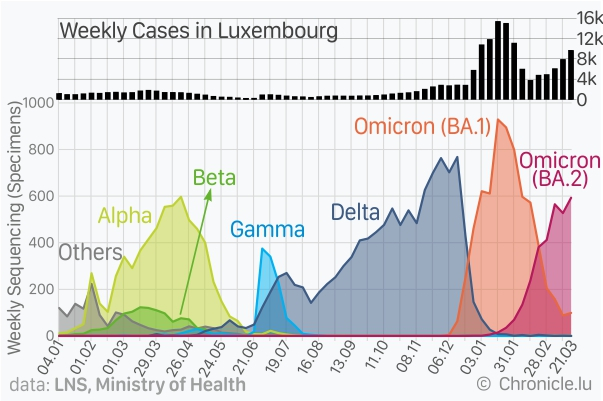
In light of the evolution of the Omicron SARS-CoV-2 variant and a recent surge in weekly COVID-19 cases in Luxembourg, Chronicle.lu reached out to the National Health Laboratory (Laboratoire national de santé - LNS) to learn more about these variants of concern.
Like the previous SARS-CoV-2 variants of concern, Alpha, Beta, Gamma and Delta, the Omicron variant too has evolved into a number of lineages and sublineages. The two most common lineages currently known are the BA.1 and BA.2. Globally, BA.3, BA.4 and BA.5 has been reported as well.
The Omicron lineages show similar symptoms upon infection as shown by people infected with earlier variants. However, Omicron lineages are more transmissible and, owing to its significant deviation from the original SARS-CoV-2 sequence, can evade post-infection or vaccine-induced immunity. Moreover, Omicron variants can reinfect people who had been infected with previous variants. While preliminary data suggest Omicron infections exhibit mild COVID-19 disease progression compared to earlier variants, some people may experience severe disease and need hospitalisation.
It is however due to the high transmissibility of Omicron that a large number of infections is currently being witnessed across the European Union (EU). According to the European Centre for Disease Prevention and Control (ECDC), Omicron represents 99.9% of all samples sequenced in the EU since late January 2022.
According to the World Health Organization (WHO), the proportion of Omicron BA.2 cases has been increasing relative to BA.1 in recent weeks, partly due to the fact that BA.2 has a growth advantage and is more transmissible than BA.1.
Amid these developments and the surge in weekly cases since mid-February 2022, as reported by Luxembourg's Ministry of Health, Chonicle.lu contacted the LNS for data regarding lineages as determined by the sequencing technique.
The data reveal that the Omicron BA.1 detection in Luxembourg coincides with the surge in new COVID-19 cases from early January 2022. The number of new cases started to decrease from the end of January but started again to peak from mid-February. These new cases coincide with the detection of the Omicron BA.2 lineage.
Currently, Omicron BA.2 is the dominant variant in circulation in Luxembourg. As of 13 March 2022, the LNS had detected 7,313 BA.1 specimens, 4 BA.1.1 specimens (a BA.1 sublineage) and 1,956 BA.2 specimens. Of these 9,273 Omicron lineages, the vaccination status was known for 5,283 (58%) cases.
Both Omicron BA.1 and Omicron BA.2 specimens showed that about 62.4% individuals were fully vaccinated whilst 37.6% were not vaccinated. In terms of the proportion of different age groups, BA.2 appeared to infect more younger people compared to the BA.1 variant.
As of 3 April 2022, Luxembourg reached a vaccination rate of 78.6% of the eligible population aged five or over.
In terms of reinfection cases, defined as two PCR confirmed SARS-CoV-2 positive tests separated by at least 90 days, only 3.9% of cases were reinfections for BA.1 specimens whilst 5.8% cases of BA.2 specimens were reinfections.