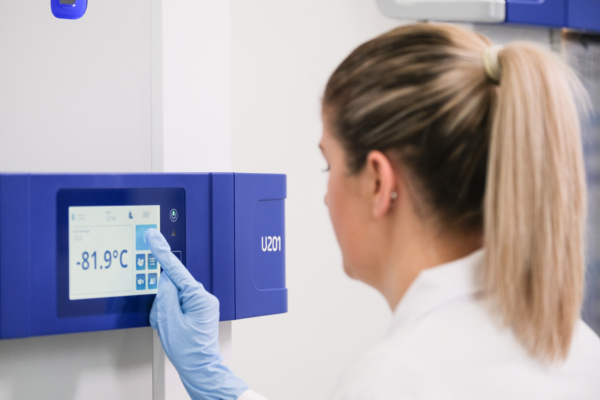
 Credit: B Medical Systems
On Thursday 3 March 2022, B Medical Systems, a Luxembourg-based global leader in medical cold chain products, has announced that its ultra-low freezer U201 has received the World Health Organisation's (WHO) Performance, Quality and Safety (PQS) prequalification, first in the world for ultra-low freezers.
Ultra-low freezers are used for storing temperature-sensitive specimens, biosamples, vaccines, etc., at temperatures as low as -86°C to enable their long-term and reliable storage. The WHO PQS process prequalifies products and devices so that member states and United Nations (UN) purchasing agencies are assured of their suitability for use in immunisation programmes.
The U201 has a gross storage volume of 214 litres and provides a storage temperature varying from -86°C to -20°C. Designed with state-of-the-art refrigeration technology, the product offers superior temperature uniformity and holdover time. U201 uses a green refrigerant that has minimal impact on the environment and is compliant with the US SNAP and EU F-Gas regulations.
The unit offers advanced inbuilt alarm systems and provides 24/7 real-time monitoring solutions via the company's Real-Time Monitoring Devices (RTMD) and °B Connected solution. The password-protected/NFC-based locking mechanism further prevents unauthorised access to the specimens. The product is certified to operate at ambient temperature as high as 43°C and is an ideal solution for last-mile vaccination campaigns, doctor's clinics, hospitals and laboratories. The U201 is also a class II(a)/II certified medical device as per EU MDR and US FDA regulation.
Luc Provost, CEO of B Medical Systems said: "It's a very proud moment for us. The WHO PQS prequalification is a testament to the quality and standard of our product. The U201 Ultra-Low Freezer offers a compact, reliable, and, sustainable ultra-low freezing solution. The unit can work at ambient temperatures as high as 43°C, making it a perfect solution to be used even in areas with harsh tropical climates. We developed this product to meet the growing demand for ultra-low temperature storage of COVID-19 vaccines. However, with the growth of mRNA technology, cell and gene therapy, we see more and more requirements for reliable ultra-low temperature storage across the world".