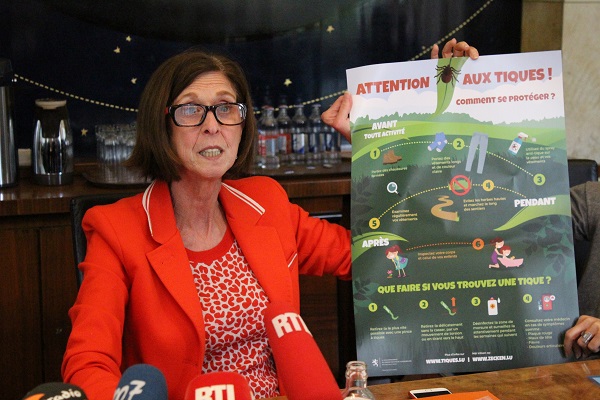
Following the petition-driven public debate which was held in February 2016 at the Chamber of Deputies, the Luxembourg Minister of Health presented the information and awareness campaign "Beware of Ticks! How to Protect Yourself?" on Friday 13 May 2016.
As tick season begins in Luxembourg, Health Minister Lydia Mutsch warned: "Too many people are still unaware of the risks that tick bites can lead to. This campaign therefore aims primarily to inform the general public about the risks and means of protection against tick bites, as well as the right actions to take if bitten."
Ticks are parasites belonging to the family of mites that feed exclusively from the blood of their hosts. They are particularly active in spring and autumn and are much more numerous after mild winters and humid spring seasons. More tick-transmitted diseases are observed in early summer (May-June) and autumn (September-October). Ticks hide on leaves and tall grass to a height of 1.5m above the ground, particularly in the underbrush, shrubs and country roads in the forest.
Diseases transmitted to humans through tick bites have increased in recent years and can have serious health consequences such as borreliosis (Lyme disease) or tick meningoencephalitis. In Luxembourg, nearly a hundred suspected borreliosis cases are reported annually. By contrast, no cases of tick-borne meningoencephalitis have yet been reported. The main affected areas are in Central and Northern Europe. There is also an effective vaccine against tick-borne meningpencephalitis.
Borreliosis, a scientifically-recognised infectious disease, most oftern heals itself but in some cases can progress to more severe stages up to cutaneous damage to the nervous system or heart damage. Once diagnosed through clinical examination and blood analysis, the disease is treatable with antibiotics. Treatment and medical consultations in this case are supported by the Caisse Nationale de Santé (CNS) according to regulations.
Diagnosis is made by combining the presence of a tick bite with suggestive signs. The serology of Lyme disease can be difficult to interpret with a lot of false positives and false negatives and often requires the use of a specialist. New diagnostic tests have recently been developed but have not yet made their scientific evidence in the diagnostic process.
"It is true that a rapid diagnosis contributes to early elimination," commented Minister Mutsch. "It is still important to sensitise the individual concerned to seek rapid consultation, after seeing the signs. Currently, a group of researchers from LIH (Luxembourg Institute of Health) is identifying people bitten by a tick in Luxembourg and hopes to improve screening tests."
There is currently no vaccine against Lyme disease transmitted by ticks. But the Luxembourg Institute of Health is working on its development and it could emerge in two years' time.
In Luxembourg, Lyme disease is identified as a reportable disease following the Grand Ducal regulation of 10 September 2004 on the designation of infectious or communicable diseases subject to mandatory reporting.
Doctors are therefore supposed to report the disease to the relevant health authority, but these statements are often and an accurate estimate of the number of cases is consequently difficult.
"A draft law requiring doctors and laboratories to report diagnosed infectious diseases, including Lyme disease, will shortly be submitted to the Governing Council in order to remedy this situation," added Lydia Mutsch.
The information and awareness campaign is primarily intended to make the public more aware of the risks faced by a tick bite and how they can be reduced. To this end, a video animation, posters and information leaflets will be sent to schools, municipalities, medical offices, sports clubs and other associations, providing information on the means of protection against tick bites and advice on what to do it bitten. Tick tweezers will also be made available to the public.
Photo by MSAN (Lydia Mutsch)