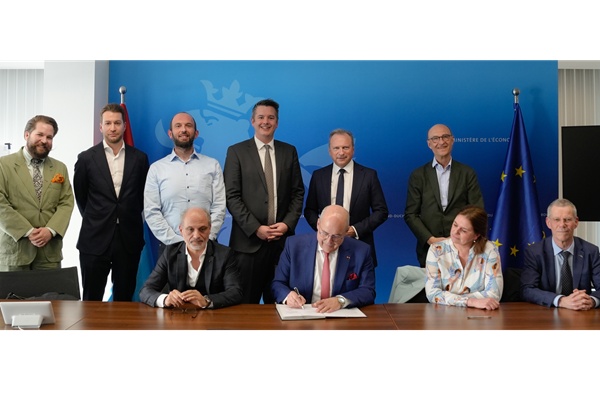
 Ministers Gilles Roth, Lex Delles and Marc Spautz, together with representatives;
Credit: MECO
Ministers Gilles Roth, Lex Delles and Marc Spautz, together with representatives;
Credit: MECO
Luxembourg's Ministry of the Economy, Ministry of Labour, Ministry of Finance, ArcelorMittal Luxembourg and the LCGB and OGBL trade unions have announced a new agreement, "LUX2029", to secure the future of ArcelorMittal in Luxembourg.
The agreement was signed by all parties involved following a negotiation process initiated on 1 October 2025.
The related conclusions of the Steel Industry Tripartite Coordination Committee were jointly signed by Luxembourg's Minister of Labour, Marc Spautz, the Minister of the Economy, SMEs, Energy and Tourism, Lex Delles, the Minister of Finance, Gilles Roth, ArcelorMittal's management and the LCGB and OGBL trade unions during their meeting on Friday 20 March 2026.
The parties underlined that the steel industry is a major pillar of European industrial sovereignty, supplying essential industrial sectors such as automotive, energy, construction and defence.
They acknowledged that Luxembourg's steel industry has been under pressure for some time, notably due to raw material prices and low-cost imports into Europe, while the geopolitical and macroeconomic environment has only worsened the situation.
To ensure a long-term future for operations in Luxembourg, the ArcelorMittal Group plans to make "significant" and "necessary" investments, while continuing to adjust its internal organisation and fixed cost structure to improve competitiveness. Luxembourg will remain the headquarters for ArcelorMittal, with the construction of the new building proceeding as planned.
The new agreement covers 2026 to 2029 and provides that ArcelorMittal will invest at least €290.5 million - and up to €334.5 million - in key projects aimed at developing all its production sites to ensure the long-term viability of its plants. This includes €44 million for maintenance of existing equipment. In addition, the parties said they will endeavour to carry out the renovation and modernisation project of "Train 2" in Esch-Belval, currently in the preliminary exploration phase.
The agreement also addresses digitalisation, with plans for a cybersecurity centre of excellence to support global operations and joint studies with academic and research institutions in the field of advanced technologies.
The creation of a "Maintenance Academy" training centre is currently under consideration. Its objective is to promote skills development and the sustainability of expertise, while creating bridges between education, industry and employment.
To address a reported workforce surplus of approximately 300 full-time equivalents, measures such as early retirement and pension schemes, short-time working, voluntary departures, internal transfers and natural attrition will be implemented. As part of the restructuring process, a redeployment unit will be set up to support affected employees throughout the process.
Moreover, two monitoring committees, comprising management representatives, the trade union signatories, staff delegation members and the Ministries of Labour, Economy and Finance, will be set up to accompany the evolution of investments and staffing levels, as well as the implementation of the various measures adopted during the period concerned. These committees will be chaired by the Minister of the Economy, SMEs, Energy and Tourism and the Minister of Labour or their delegates.