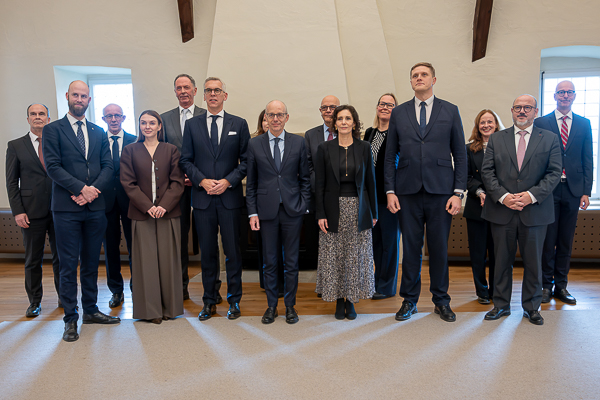
 Group photo;
Credit: Ali Sahib, Chronicle.lu
On Friday 20 November 2026, Luxembourg's Ministry of Home Affairs held a press conference following the fourth meeting of the European Coalition on Civil Preparedness and Resilience, hosted in Luxembourg on Thursday 19 and Friday 20 November 2026.
The speakers included Luxembourg's Minister for Home Affairs Léon Gloden, European Commissioner for Equality, Preparedness and Crisis Management Hadja Lahbib and Valeriia Ivanova, a senior adviser at the German Marshall Fund of the United States (US) and co-author of Unbreakable Kherson, a book examining Ukraine's experience of maintaining essential services and strengthening resilience during Russia's full-scale invasion.
The two-day meeting took place at the initiative of Minister Gloden, in cooperation with Luxembourg's High Commission for National Protection and in the presence of Prime Minister Luc Frieden.
According to the ministry, Prime Minister Frieden highlighted the need for greater European resilience in response to cyberattacks, climate-related risks and threats to critical infrastructure, stressing the importance of protecting citizens and maintaining stability.
Speaking at the press conference, Minister Gloden highlighted insights shared by Romania, Poland, Lithuania and the Netherlands. He also emphasised lessons from Ukraine, particularly the importance of digitalisation, countering disinformation and equipping firefighters to respond to emergencies.
Minister Gloden further referred to Luxembourg's national resilience strategy, presented in October 2025, which involves government institutions, municipalities and citizens in preparing for potential crises.
European Commissioner Lahbib noted that the coalition now represents more than 40% of the EU population. "This is a milestone. And it also shows that our awareness is growing," she said.
She highlighted differences in preparedness across Europe, noting that Nordic and Baltic countries have developed stronger preparedness measures due to their proximity to Russia, while other countries face challenges including cyberattacks and disinformation. "The time to prepare for the next crisis is now," she stressed.
Hadja Lahbib also outlined European Union (EU) efforts to develop a comprehensive risk and threat assessment covering all 27 Member States, alongside preparedness recommendations addressing emergency supplies, education in schools and the inclusion of people with disabilities.
Valeriia Ivanova then presented the publication, which contains more than 30 chapters and over 100 recommendations based on Ukraine's experience. "These are not theoretical ideas, but real decisions, real mistakes," she said, adding that Ukraine's experience could help other European countries to prepare better.
Answering the questions after the presentation, Hadja Lahbib was asked about Europe's biggest weaknesses in responding to future crises.
"The biggest weakness is that we need to change the mindset. We need to change the culture," she replied, referring to the COVID-19 pandemic as an example of how a seemingly "microscopic" threat can have global consequences.
According to the ministry, participating countries agreed to strengthen cooperation through joint exercises, exchanges of experience and measures to protect critical infrastructure, while promoting crisis preparedness among institutions and citizens.
Launched by the Netherlands in May 2025, the coalition aims to strengthen cooperation between European countries in anticipating and responding to crises. Romania recently joined as its twelfth member, alongside countries including Luxembourg, Poland, Germany and the Nordic and Baltic states.