
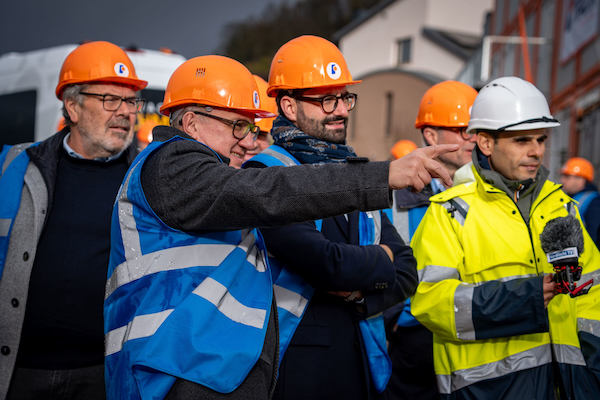
 (L-R) Jean-Paul Zeimes, Mayor of Schieren; Roland Fox, Director of the Administration of Bridges and Roads; Eric Thill, Luxembourg Minister of Culture; n.c.;
Credit: MCULT
On Friday 20 November 2026, Eric Thill, Luxembourg’s Minister of Culture, representing Yuriko Backes, Minister for Mobility and Public Works, officially marked the start of construction work to widen the B7 between Schieren and Ettelbruck.
According to Luxembourg’s Ministry of Mobility and Public Works and the Roads and Bridges Administration, the ceremony, attended by Jean-Paul Zeimes, Mayor of the Municipality of Schieren, was held to mark the next step towards improving connections between the centre and the north of the country. By upgrading a key section of the national road network, it will help make daily journeys smoother, safer and better suited to current and future mobility needs.
A major infrastructure project to improve connections between central Luxembourg and Nordstad
The project aims to widen the B7 to two lanes in each direction between the Colmar-Berg viaduct and the Ettelbruck interchange, covering a distance of approximately two kilometres. It also includes bringing the existing infrastructure up to current standards and ensuring continuity with the standard cross-section of the A7 motorway.
As a direct continuation of the A7 motorway, this section of the B7 currently has only three lanes, resulting in significant traffic congestion during peak hours. Widening it to two lanes in each direction has three main objectives: improving traffic flow, enhancing road safety by separating opposing directions of traffic, and strengthening the connection between central Luxembourg and the north of the country.
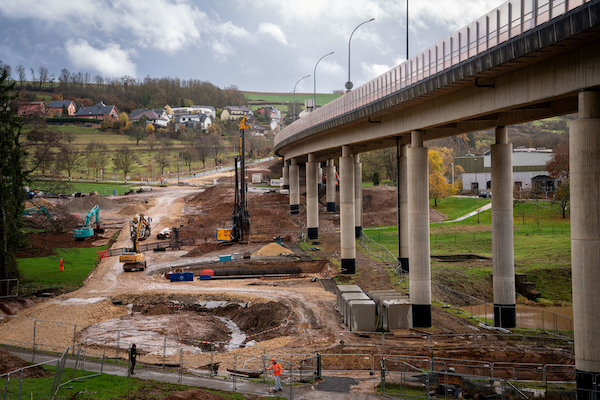
The project represents a major construction undertaking, with work expected to take approximately four years and the full opening scheduled for the end of 2030. The complexity of the project is due in particular to the construction of a second viaduct alongside the existing Schieren viaduct, which is one of the project's main components, the adaptation of existing infrastructure and the need to maintain traffic flow throughout the construction period. Building this new parallel structure will itself require approximately three years of work.
The project also incorporates ecological compensation measures to be implemented in advance, noise protection measures for local residents and close cooperation with the National Institute for Archaeological Research (INRA) to preserve archaeological remains located near the route.
The construction phases have been organised to keep two traffic lanes open throughout most of the works, thereby minimising disruption for daily road users.
 Credit: MCULT