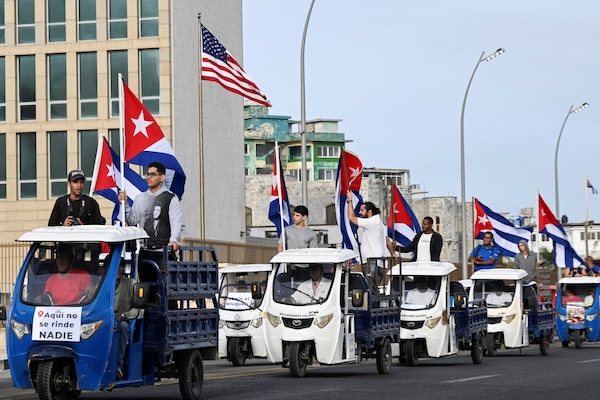
 People riding in electric vehicles carry Cuban flags as they pass by the U.S. Embassy during an anti-imperialist march amid a months-long energy crisis since U.S. President Donald Trump's administration cut off its fuel supply, Havana, Cuba 2 April 2026.;
Credit: Reuters/Norlys Perez
People riding in electric vehicles carry Cuban flags as they pass by the U.S. Embassy during an anti-imperialist march amid a months-long energy crisis since U.S. President Donald Trump's administration cut off its fuel supply, Havana, Cuba 2 April 2026.;
Credit: Reuters/Norlys Perez
HAVANA (Reuters) - On Thursday 2 April 2026, Cuban activists paraded on bikes and electric tricycles along Havana's waterfront Malecon boulevard, accompanied by Cuban President Miguel Díaz-Canel, in a show of defiance amid US efforts to starve the island of fuel.
Participants in the government-organised caravan rode past the US Embassy in the Cuban capital, their electric and pedal-powered vehicles displaying flags and banners attacking the sanctions imposed on the country by President Donald Trump's administration.
The rally came a day after Cuba's top diplomat in Washington publicly invited the US government to help overhaul Cuba's crippled economy as part of ongoing negotiations that have yet to yield results.
Participants in the rally said they favoured talks with the United States but demanded respect for Cuba.
"I believe that genuine dialogue between both governments is possible, but international law and our country's autonomy must be respected," said Sheila Ibatao, a Havana law student and participant.
Diaz-Canel did not speak during the event.
The Cuban government often organises large rallies at the US Embassy. This caravan was smaller and more discreet, hampered by fuel shortages that have crippled mobility and hobbled public transport.
A Russian-flagged tankership arrived in Cuba this week and off-loaded 700,000 barrels of crude oil, promising some relief in the coming weeks.
The Trump administration, which has threatened to slap tariffs on countries that export oil to Cuba and explicitly prohibited imports of Russian oil, said it allowed the Russian-flagged tanker to dock in Cuba's Matanzas port for humanitarian reasons.