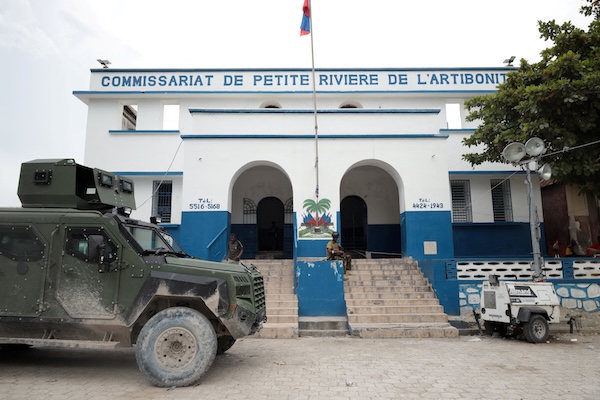
 File Photo: A police vehicle is parked in front of a police station in Artibonite department in central Haiti, 29 August 2025;
Credit: Reuters/Fildor Pq Egeder/File Photo
File Photo: A police vehicle is parked in front of a police station in Artibonite department in central Haiti, 29 August 2025;
Credit: Reuters/Fildor Pq Egeder/File Photo
PORT-AU-PRINCE (Reuters) - Armed men mounted further attacks in Haiti's breadbasket Artibonite region on Tuesday 31 March 2026, days after a gang's weekend assault in the area of Jean-Denis left some 70 people dead, according to human rights groups and local residents.
National police said it was conducting operations in several parts of Artibonite on Tuesday.
Residents of Jean-Denis counted 70 bodies on Sunday morning after an attack by the Gran Grif gang, the National Network for the Defence of Human Rights (RNDDH) said in a report, matching the estimates of the Defence Plus rights group but far above official estimates, which put the death toll at around sixteen.
RNDDH said some 30 more people were wounded, and victims included infants, pregnant women, teenagers and an 80-year-old man.
Armed men withdrew from Jean-Denis on Monday 30 March 2026, RNDDH said, but on Tuesday they repositioned themselves in nearby Pont Benoit and were attempting to launch another offensive in the town of Marchand Dessalines, some 19 kilometres north.
Videos shared on social media showed armed men reportedly belonging to the Kokorat San Ras gang, a close ally of the powerful Gran Grif, distributing cash to residents in Marchand Dessalines. Gran Grif has been designated a terrorist organisation by the US and the neighboring Dominican Republic.
Residents told Reuters local self-defence brigades did not have the firepower to hold off the gangs, which would wait during the day when police were present but begin shooting and setting fire to buildings at night.
Limited Security Rersponse
RNDDH, whose report followed interviews with local authorities, police and residents, said Gran Grif's attack on Jean-Denis followed weeks of threats and residents did not flee because they believed the self-defense brigade would protect them.
The self-defence brigade however withdrew as they did not have the firepower to hold off the attack, RNDDH said.
The police response was limited, it noted, with armored vehicles that managed to reach the scene staying just a few hours before withdrawing and returning on Monday.
Local authorities told the rights group most of their armoured vehicles were out of service, some because of battery issues that required help from mechanics based in Port-au-Prince, and that units belonging to the UN-backed security force had to await authorisation from the capital before deploying.
Meanwhile on Tuesday, Prime Minister, Alix Didier Fils-Aime, received a UN delegation with whom he discussed the arrival of an expanded mission of a so far only partially deployed security force, which has suffered from lack of equipment, troops and funds.
In a report the same day, US-based nonprofit, IJDH, criticised state and international measures that it said prioritised short-term militarised responses while cutting aid, mass deporting migrants and relying on non-state actors - including a US private military company and the self-defence brigades - which are both accused of extrajudicial killings.
"Haiti's already catastrophic social and economic landscape has deteriorated further," it said, adding neither the prime minister nor the UN-backed deployment "appears set up to transform the dynamics underlying the failures of their predecessors."