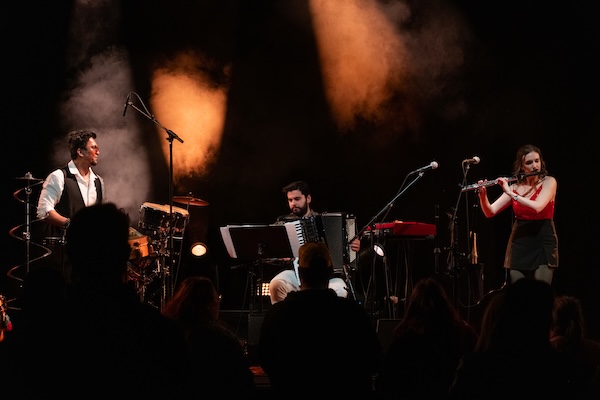
 Authentica in 2025;
Credit: Ali Sahib, Chronicle.lu
Authentica in 2025;
Credit: Ali Sahib, Chronicle.lu
On Friday 6 March 2026, the Opderschmelz cultural centre together with the City of Dudelange held a press conference ahead of the upcoming 30th edition of the Zeltik Festival, dedicated to Celtic music and culture, which will take place from Thursday 12 to Sunday 15 March 2026.
The press conference took place at Kantin, the brewery in Dudelange. John Rech, Director of the Opderschmelz cultural centre, Dan Biancalana, Mayor of the City of Dudelange, and Loris Spina, Alderman in charge of culture for the City of Dudelange, presented the programme for this year's edition, which will feature concerts across three different venues in Dudelange.
The representatives shared some of the festival’s history, saying that “what began 29 years ago as a joint venture between the Municipality of Dudelange and the local fire brigade has evolved into one of the leading Celtic music festivals within hundreds of kilometres”.
They continued by outlining the festival’s previous venues across Dudelange, such as a large tent at Place Jean Fohrmann in 1997, Annexe Alliance sports hall in 2013, where it took place until 2020, and during the COVID-19 pandemic, in 2021, the festival took place at the Opderschmelz cultural centre, first in the car park and later inside the cultural centre.
Over the course of its history, the festival has also evolved from a one day event into a four-day programme, welcoming more artists and attracting more than 2,000 attendees each year. The representatives noted that this anniversary edition honours the festival’s long history while remaining faithful to its spirit of musical discovery, bringing together returning artists, fan favourites and new voices from today’s Celtic music scene.
Each venue will offer a different setting for the programme. The Zeltik Prelude concerts will be held at St Martin Church, where selected headliners from the festival line-up will perform in an “extraordinary” musical atmosphere. Featured artists will include Carlos Núñez, Kevin and Friends from Red Hot Chilli Pipers, Tom and Kalissa from The Paperboys and Brian Brody. The performances will be accompanied by the local organist Laurent Felten.
The main concerts will take place at the Opderschmelz cultural centre’s main hall, presenting a range of Celtic music from traditional sounds to contemporary interpretations. In addition, the Display space within the venue will transform into a pub-inspired setting. There visitors will find a selection of local drinks, while the in-house restaurant AmarCord and food trucks in front of the cultural centre will provide catering.
On Friday and Saturday nights, the festival will continue with after-show parties at Kantin. Following the official concert programme, selected festival artists will perform again in an informal setting, allowing audiences to extend the festival experience late into the night.
The festival line-up will include artists from across Europe and beyond, featuring: Carlos Núñez (Galicia, Spain); Red Hot Chilli Pipers (Scotland); Skerryvore (Scotland); The Paperboys (Canada); Curly Strings (Estonia); Ryan Young (Scotland); The Celtic Social Club (France / Ireland); Andrew Strong (Ireland); Achtung Babies (Italy); Authentica (Luxembourg); Brian Brody (Ireland).
The organisers emphasised the importance of encouraging audiences to discover new things rather than “simply consume culture”. They also highlighted that the event brings together people from different cultures and promotes participation, creativity and cultural exchange.
Speaking with Chronicle.lu, John Rech specified that this will be the 30th edition of the festival, instead of a 30-year anniversary. “The distinction comes from the fact that two editions took place in 2022, one in March and one in summer during the European Capital of Culture programme. The festival will therefore celebrate its 30th anniversary next year,” he said.
Asked about the festival’s focus on Celtic music, he noted that it remains “one of the few events in the wider region dedicated specifically to Celtic music”. He continued: “Celtic music filled a niche in the cultural landscape, particularly during the 1990s when it experienced strong popularity across France and Germany,” adding that the genre stands out for “a very high level of musicianship and a welcoming atmosphere among artists”.
John Rech also explained that a distinctive element of the festival is the strong sense of collaboration among musicians. After the main concerts, performances continue during the after show sessions at Kantin, where artists often join each other on stage in an informal setting. According to the director, this atmosphere of “openness and exchange” has become one of the defining features of the event. “There is a lot of sharing at this festival,” he said, noting that musicians from different bands frequently play together during the late night sessions.