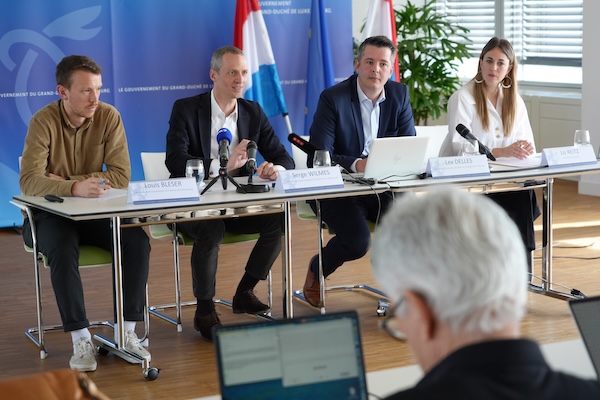
 (L-R) Louis Bleser, Luxembourg's Ministry of the Environment; Serge Wilmes, Luxembourg's Minister of the Environment, Climate and Biodiversity; Lex Delles, Luxembourg's Minister of the Economy, SMEs, Energy and Tourism; Liz Reitz, Ministry of the Economy;
Credit: MECB
(L-R) Louis Bleser, Luxembourg's Ministry of the Environment; Serge Wilmes, Luxembourg's Minister of the Environment, Climate and Biodiversity; Lex Delles, Luxembourg's Minister of the Economy, SMEs, Energy and Tourism; Liz Reitz, Ministry of the Economy;
Credit: MECB
On Friday 17 April 2026, Luxembourg’s Minister of the Environment, Climate and Biodiversity, Serge Wilmes, and the Minister of the Economy, SMEs, Energy and Tourism, Lex Delles, presented the Social Climate Plan, adopted by the Government Council on Friday 27 March 2026.
According to Luxembourg’s Ministry of the Environment, Climate and Biodiversity and the Ministry of the Economy, the ministers outlined the main objectives of the plan, which includes direct support schemes, accompanying measures and new opportunities to facilitate access to more sustainable mobility and energy solutions. The plan also introduces key measures to address socio-economic challenges related to building renovation, the integration of renewable energy and access to electromobility.
“A credible climate policy is based on a clear principle: ensuring an ecological transition that includes the entire population. The Social Climate Plan reflects this requirement and ensures that the transition, carried out collectively, is based on protection, fairness and solidarity, particularly for the most exposed households and stakeholders,” Minister Wilmes stated.
“The energy transition is not only a climate imperative, it is also a form of protection. With the Social Climate Plan, we ensure that every micro-enterprise and household, particularly the most vulnerable, can access sustainable solutions while being supported in the face of rising fossil energy costs. Our commitment is clear: an ambitious, fair and sustainable energy transition for all,” Minister Delles added.
According to the ministries, the plan includes 45 measures, combining existing schemes and new initiatives aimed at supporting vulnerable households, micro-enterprises and transport users.
It provides for direct support schemes, accompanying measures and new opportunities to facilitate access to more sustainable mobility and energy solutions. It also introduces key measures to address socio-economic challenges related to building renovation, the integration of renewable energy and access to electromobility.
The ministries noted that the plan is based on a dual approach: compensating for costs linked to carbon pricing and supporting households in transitioning to more sustainable solutions.
It covers a wide range of areas, including energy renovation of buildings, integration of renewable energy and access to electromobility, while taking into account the realities faced by tenants, homeowners, micro-enterprises and transport users.
The plan also constitutes a prerequisite for accessing funding from the European Social Climate Fund.
The ministries added that the plan is the result of close cooperation between several ministries and stakeholders, coordinated by the Interministerial Committee for Climate Action.
A consultation process launched in March 2025 included an online questionnaire, bilateral exchanges with stakeholders in the social sector, contributions from relevant platforms and observatories, a public information session, a public consultation and analytical support from STATEC.
During the presentation, the ministers highlighted several concrete measures included in the plan, such as the “Top-up social” housing support scheme, the gradual introduction of pre-financing for “Klimabonus Wunnen” and “Klimabonus Mobilitéit”, support for photovoltaic installations on affordable housing, assistance for households in energy poverty and the creation of a single social contact point.
Additional measures include the renovation of vacant housing, a study on rental challenges related to the energy transition, pre-financing of the Top-up social scheme and the sharing of renewable electricity with vulnerable households and micro-enterprises.
A “social car leasing” system is also planned, offering long-term contracts with reduced monthly payments to ensure affordable, zero-emission mobility for low- and middle-income households.
A central measure of the plan is the social compensation of the CO₂ tax through a CO₂ tax credit, aimed at protecting lower-income households from rising costs and preserving their purchasing power.