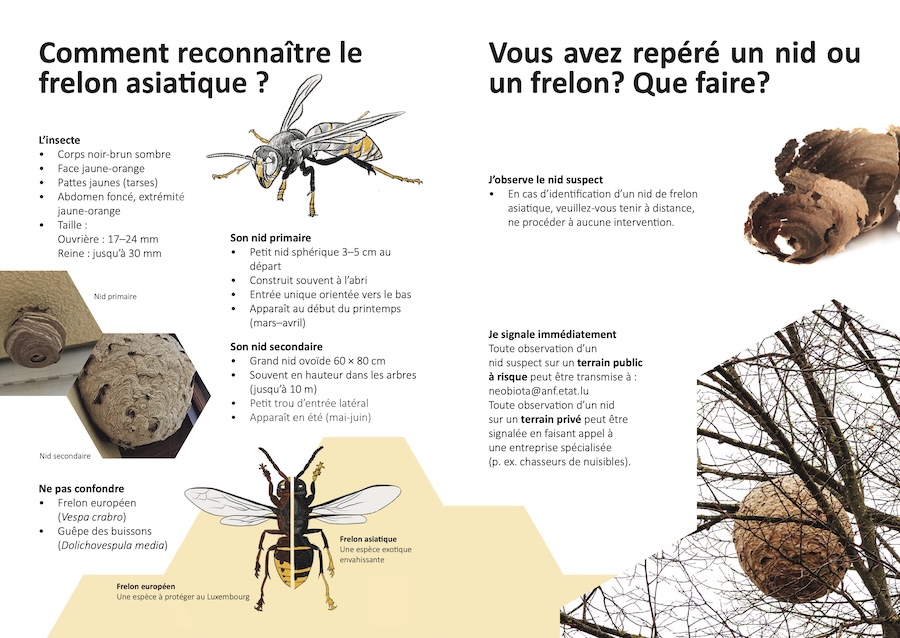
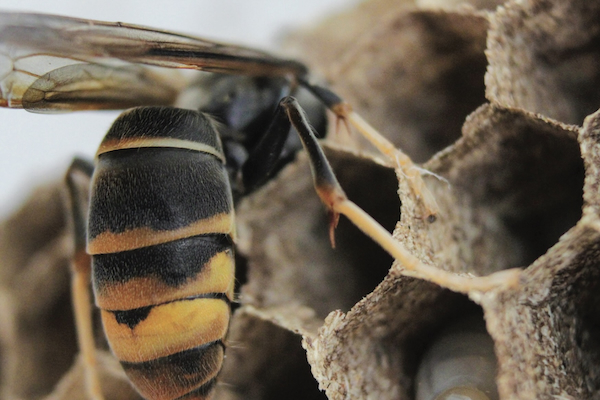
 Credit: Luxembourg Ministry of the Environment, Climate and Biodiversity
On Wednesday 8 April 2026, Luxembourg’s Ministry of the Environment, Climate and Biodiversity and the Nature and Forestry Administration published its emergency plan on the prevention and management of the introduction and spread of invasive alien species, specifically the Asian hornet.
The ministry said that as part of the fight against the Asian hornet (Vespa velutina nigrithorax), listed as an invasive alien species of concern to the European Union in accordance with Regulation (EU) No 1143/2014 on the prevention and management of the introduction and spread of invasive alien species, the emergency plan aims to organise a rapid and coordinated response in order to limit the spread of the Asian hornet and protect local biodiversity.
According to the ministry, in Luxembourg, the Asian hornet continues to spread, a phenomenon intensified by global warming, which favours the survival of founding queens and the growth in the number of colonies. This species poses a direct threat to local biodiversity, particularly to pollinators. For the public, the Asian hornet does not pose an immediate threat as long as nests are not disturbed and interventions are carried out by experts.
In order to organise a coherent and effective national response, a national management plan is currently being updated. This work is being carried out by a group of experts under the coordination of the Nature and Forestry Administration, the Technical Agricultural Services Administration, and the Luxembourg Veterinary and Food Administration. This system is complemented by the 2026 emergency plan, which defines the immediate actions to be implemented to limit the spread of the species.
The ministry highlighted that the central action of the 2026 emergency plan is based on the targeted removal of primary nests, that is, nests built in spring by founding queens. This early intervention is crucial because it: significantly reduces the number of colonies likely to develop during the summer; helps avoid more dangerous and technically complex summer interventions; and is the most effective method to limit the impact on pollinator populations.
Financial Support for Private Land
To support the early neutralisation of Asian hornet nests, the ministry is introducing in 2026 a financial support mechanism for private landowners. This support covers part of the costs associated with the intervention of a specialised operator for the destruction of nests:
⁃ primary nests in early stages: flat-rate support of up to €50;
⁃ primary nests in advanced stages: flat-rate support of up to €100;
⁃ secondary nests (generally larger and more complex): flat-rate support of up to €300.
To benefit from this support, the intervention must be carried out by a trained operator and comply with best practices for neutralisation, including the absence of dispersal of biocides into the environment and correct identification of the species. Owners are encouraged to contact a specialist company (pest control operators). The application form and the conditions for assistance are available on the guichet.lu platform. Applications can be submitted via email: neobiota@anf.etat.lu.
On public land, interventions remain the responsibility of the Nature and Forestry Administration.
Importance of Correct Species Identification
The ministry stressed that distinguishing between the Asian hornet and native species, particularly Vespa crabro, is essential. The European hornet is a beneficial species and is not subject to any control measures. The public is encouraged to consult official identification materials and to report a suspected nest via the dedicated platforms, without attempting any personal intervention.
A National Commitment to Biodiversity and Beekeeping
The management of the Asian hornet is part of a broader strategy to protect Luxembourg’s biodiversity and strengthen the resilience of ecosystems in the face of climate change.
Serge Wilmes, Luxembourg Minister of the Environment, Climate and Biodiversity, stated: “Protecting our biodiversity is a national priority. The fight against the Asian hornet must be conducted in a coordinated, scientifically sound manner and in close cooperation with municipalities, experts, beekeepers and the general public. The 2026 emergency plan reflects our determination to act early, effectively and in solidarity in the face of this growing threat.”